
Understanding the Chinese of Chinese: Navigating Different Meanings
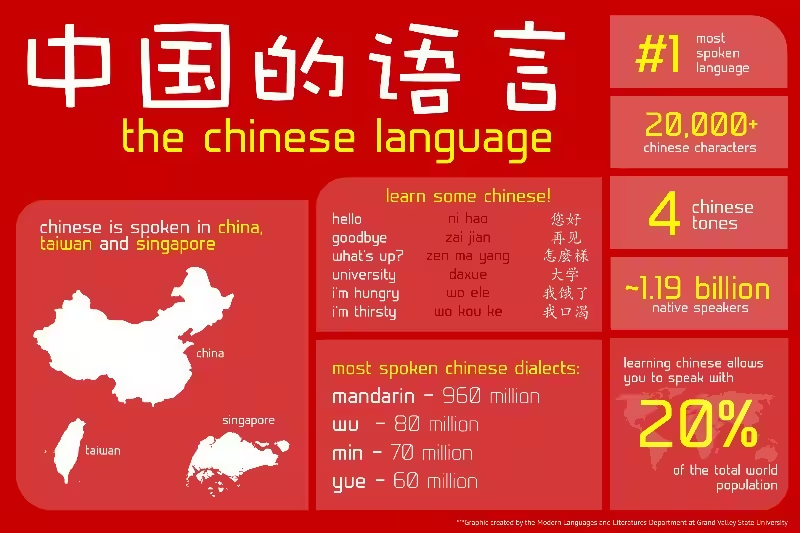
This article delves into the multifaceted concept of "Chinese" when discussing the language within the Chinese context. It explores various ways to express "Chinese" in Mandarin Chinese, clarifying the nuances associated with the term, and highlighting the importance of context in communication.
- Different Ways to Say "Chinese" in Mandarin
- Beyond the Basics: Other Important Terms
- Nuances and Contextual Considerations
- Examples in Conversation
-
FAQ: Understanding "Chinese" in Mandarin Chinese
- Q1: What is the most common and direct translation for "Chinese" (referring to Mandarin)?
- Q2: What does "汉语 (Hàn yǔ)" mean, and how does it relate to "Chinese"?
- Q3: What is "普通话 (Pǔ tōng huà)" and why is it important?
- Q4: How is "国语 (Guó yǔ)" used, and in what context?
- Q5: What is "华语 (Huáyǔ)", and when is it used?
- Q6: Why are there different terms for "Chinese"?
- Q7: Can you explain the concept of "diglossia" in relation to Chinese?
- Q8: How does the written form of Chinese differ from the spoken form?
- Q9: What is Standard Mandarin, and why is it important?
- Q10: What are simplified and traditional characters?
- Q11: How many speakers are there of Mandarin?
- Q12: Are all Chinese languages mutually intelligible?
- Q13: What is the relationship between Chinese and other languages in Asia?
- Q14: What are the different tonal systems in Chinese?
- Q15: How does Chinese grammar differ from English grammar?
- Q16: What is the history of the written Chinese language?
- Q17: What are the challenges in standardizing Chinese pronunciation?
- Q18: How has the language and writing system of Chinese evolved?
- Q19: What role does the official national language play in China?
- Q20: What is the significance of Chinese language in the modern world?
Different Ways to Say "Chinese" in Mandarin
The term "Chinese" in English can be ambiguous, often referring to either the Mandarin language or the vast collection of languages spoken across the Chinese diaspora. Conversely, the Chinese language itself provides distinct terms for Mandarin, each with subtle meanings and contexts of use.
The most common and direct translation for "Chinese" (referring to Mandarin) is 中文 (zhōng wén), literally meaning "central language." This term directly reflects the perceived centrality of China in the region, mirroring the concept of "zhongguo" (中国), the country itself. It's a straightforward and widely used term in formal and informal settings. Meanwhile, this term is especially suitable when referring to the written language.
Another prevalent term is 汉语 (Hàn yǔ), meaning "Han language." This term emphasizes the language's connection to the Han Chinese, the majority ethnic group in China. This term is frequently used in academic settings and discussions about the language's historical development. It's also widely accepted, especially in academic and cultural contexts, where the historical significance of the Han Chinese in shaping the language is emphasized.
Beyond the Basics: Other Important Terms
普通话 (Pǔ tōng huà), translating to "common speech," is another frequently used term for Mandarin. This term focuses on the standardized nature of Mandarin and its widespread use across China. It's particularly suitable when discussing the standard language as taught in schools or used in formal communication. This aligns with the historical push for a unified language across China.
A term particularly relevant in Taiwan is 国语 (Guó yǔ), signifying "national language." This emphasizes the language's official status within the country and its importance in national identity. This term is directly tied to the Republic of China's history and focus on national unity. It is particularly relevant in discussions about the language's role in fostering a shared identity among Taiwanese citizens.
Lastly, 华语 (Huáyǔ) is frequently employed outside China, especially in Southeast Asia. This term describes the language of the Chinese people (华人, huá rén). It's a more inclusive term, encompassing not only Mandarin Chinese but also other Chinese dialects. This term is often preferred in international contexts, as it acknowledges the diversity of Chinese languages without being overly specific. It also speaks to the large Chinese diasporas that exist globally.
Nuances and Contextual Considerations
Understanding these different terms is crucial for accurate communication. For example, using "中文 (zhōng wén)" when discussing the written form of Mandarin is appropriate, while "普通话 (Pǔ tōng huà)" might be better suited for conversations about the standardized spoken language. Context is key. In Taiwan, "国语 (Guó yǔ)" would be the natural choice, while "华语 (Huáyǔ)" might be more suitable for discussions with Chinese speakers in Southeast Asia.
Examples in Conversation
To illustrate the importance of choosing the right term, consider the following example:
-
你 会 说 普通话 吗? (nǐ huì shuō pǔ tōng huà ma?) This translates to "Can you speak Mandarin?" Using "普通话" in this context is the most natural and accurate way to express the specific meaning.
-
你会说汉语吗? (nǐ huì shuō hàyǔ ma?) This also translates to "Can you speak Chinese?", however, in this context, it would be more suitable to use "汉语" if you are discussing the broader Han Chinese language.
-
你会说中文吗? (nǐ huì shuō zhōngwén ma?) Again, the meaning is the same, but in this context "中文" is more appropriate and fitting when discussing the written form of the language.
By understanding the subtle distinctions between these terms, you can navigate conversations about the Chinese language with greater clarity and precision, avoiding any potential misunderstandings.
The Chinese language offers a rich tapestry of words to describe its own various forms. While "Chinese" in English can be ambiguous, Mandarin speakers have a range of specific terms to express the concept, each with nuances that reflect cultural and linguistic context. Mastering these nuances allows for more precise and accurate communication, crucial in a world of diverse linguistic backgrounds. Ultimately, understanding these different ways to express "Chinese" in Chinese is essential for effective communication and appropriate cultural sensitivity.
FAQ: Understanding "Chinese" in Mandarin Chinese
This FAQ addresses the various ways to express "Chinese" in Mandarin Chinese, acknowledging the nuances and contextual differences.
Q1: What is the most common and direct translation for "Chinese" (referring to Mandarin)?
A1: The most common and direct translation for "Chinese" (referring to Mandarin) is 中文 (zhōng wén), literally meaning "central language." This reflects the historical and cultural perception of China as the "central country."
Q2: What does "汉语 (Hàn yǔ)" mean, and how does it relate to "Chinese"?
A2: 汉语 (Hàn yǔ) means "Han language." Given the predominant Han Chinese population in China, this term effectively describes Mandarin Chinese.
Q3: What is "普通话 (Pǔ tōng huà)" and why is it important?
A3: 普通话 (Pǔ tōng huà) translates to "common speech." It signifies the standardized form of Mandarin, widely used across China and crucial for communication.
Q4: How is "国语 (Guó yǔ)" used, and in what context?
A4: 国语 (Guó yǔ) signifies "national language." This term emphasizes the language's status within a particular country, often used in Taiwan to reflect national identity.
Q5: What is "华语 (Huáyǔ)", and when is it used?
A5: 华语 (Huáyǔ) is frequently used outside China, especially in Southeast Asia. It describes the language of the Chinese people (华人, huá rén).
Q6: Why are there different terms for "Chinese"?
A6: The different terms for "Chinese" in Mandarin reflect the different contexts and nuances. "Chinese" in English can be ambiguous, referring to either Mandarin or Cantonese, whereas Mandarin Chinese has specific terms to avoid confusion in context.
Q7: Can you explain the concept of "diglossia" in relation to Chinese?
A7: Diglossia in Chinese refers to the complex relationship between spoken and written Chinese. Spoken varieties evolve at different paces, while the written language (using characters) remains relatively stable.
Q8: How does the written form of Chinese differ from the spoken form?
A8: The written form of Chinese, primarily logographic characters, predates recorded spoken forms. The spoken form has evolved significantly over time, influenced by geographic and political factors.
Q9: What is Standard Mandarin, and why is it important?
A9: Standard Mandarin, based on the Beijing Mandarin dialect, emerged as the official national language in the 1930s. It is crucial for education, governance, and media across China.
Q10: What are simplified and traditional characters?
A10: Simplified characters are used in mainland China and Singapore, while traditional characters are used elsewhere. This reflects the historical and political changes in the region.
Q11: How many speakers are there of Mandarin?
A11: Mandarin, with approximately 800 million speakers, is the most prevalent language spoken by Han Chinese.
Q12: Are all Chinese languages mutually intelligible?
A12: No, while native speakers often view these varieties as dialects, significant lack of mutual intelligibility frequently leads to their classification as separate languages within the Sinitic branch of the Sino-Tibetan family. Mandarin, Min, Wu, and Yue (Cantonese) are examples of major branches.
Q13: What is the relationship between Chinese and other languages in Asia?
A13: Chinese has profoundly impacted neighboring cultures. Historical interactions, including periods of political control and the spread of Buddhism, led to the adoption of Chinese characters for writing in Korea, Japan, and Vietnam, and the extensive borrowing of Chinese morphemes into these languages.
Q14: What are the different tonal systems in Chinese?
A14: Modern Chinese varieties are tonal, with varying degrees of tonal complexity across regions. Standard Mandarin, for example, employs four tones plus a neutral tone.
Q15: How does Chinese grammar differ from English grammar?
A15: Modern Chinese is largely analytic, relying on word order and grammatical particles rather than inflection to convey grammatical relationships. This contrasts with English, which relies significantly on morphological inflection.
Q16: What is the history of the written Chinese language?
A16: The written form of Chinese, primarily using logographic characters, predates recorded spoken forms, with oracle bone inscriptions dating back to the Shang dynasty (c. 1250 BCE).
Q17: What are the challenges in standardizing Chinese pronunciation?
A17: Historical attempts to standardize pronunciation, including the Qieyun rhyme dictionary, reflect the challenges of unifying the diverse spoken varieties.
Q18: How has the language and writing system of Chinese evolved?
A18: The evolution of Chinese has involved significant sound changes driven by geographic and political separation. The development of spoken Chinese, from Old to Middle Chinese, and historical attempts to standardize pronunciation are key aspects of its evolution.
Q19: What role does the official national language play in China?
A19: Standard Chinese, plays a crucial role in education, governance, and media. This standard reflects attempts to unify the language.
Q20: What is the significance of Chinese language in the modern world?
A20: The continued evolution and influence of Chinese, both within and beyond its geographic borders, demonstrate its linguistic and cultural significance. It's a crucial language for communication and understanding in a globalized world.