
The 3 Wise Men Chinese: Understanding Fu, Lu, and Shou
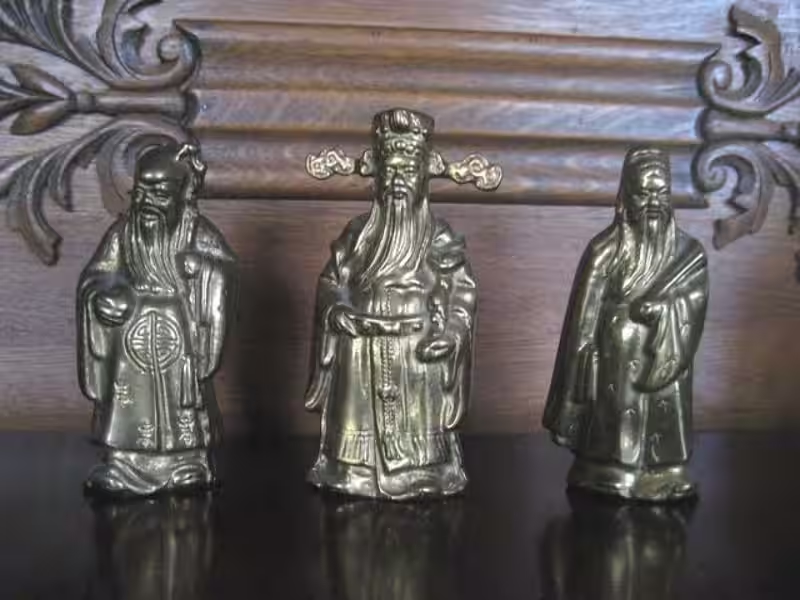
The Sanxing, or Three Stars, are deeply ingrained in Chinese culture, symbolizing fortune, prosperity, and longevity. These deities, often represented as wise, bearded elders, aren't merely figurines; they're potent symbols of a desired life. This article delves into the fascinating world of the 3 wise men Chinese, exploring their origins, significance, and proper placement.
- Unveiling the Three Stars: Origins and Significance
- The Individual Deities: Fu, Lu, and Shou
- Placing the 3 Wise Men Chinese for Optimal Influence
- Beyond Symbolism: Personal Connection
-
Frequently Asked Questions about the Sanxing (Three Stars)
- What are the Sanxing (Three Stars)?
- Who are Fu, Lu, and Shou?
- Why are they important in Chinese culture?
- How are they typically displayed?
- What are some common misconceptions about the Sanxing?
- What is the significance of their placement in Feng Shui?
- How do the Sanxing figures reflect cultural values?
Unveiling the Three Stars: Origins and Significance
The 3 wise men Chinese, known as Fu, Lu, and Shou, are more than just figurines; they represent fundamental concepts of a fulfilling life. Emerging from a rich tapestry of folk religion and mythology, these deities are deeply entwined with Chinese culture. Their representation as three wise, bearded elders solidified during the Ming dynasty. This transition from celestial bodies to personified deities is a testament to the power of storytelling and the human need to imbue the cosmos with meaning. Their stories, interwoven with historical figures and astronomical bodies, add layers of cultural meaning.
Their prominence in temples, ancestral shrines, homes, and shops, particularly during Chinese New Year, underscores their vital role in shaping auspicious environments. Their carefully arranged positions (Shou on the left, Lu in the middle, and Fu on the right) mirror the traditional Chinese writing style, adding an aesthetic and symbolic depth to their presence. This arrangement is not merely decorative; it embodies a carefully crafted balance of energies.
The Individual Deities: Fu, Lu, and Shou
Each of the 3 wise men Chinese embodies a distinct aspect of a good life.
Fu: The Deity of Fortune
Fu, representing fortune, is associated with Jupiter. Beyond general prosperity, a Taoist myth connects Fu's origins to Yang Cheng, a Tang dynasty official who championed the release of court slaves. This historical connection imbues Fu with a deeper meaning, linking prosperity to ethical actions. His image typically depicts him in scholar's attire, holding scrolls, often surrounded by children. This visual representation underscores his role in fostering good fortune for families and future generations. Interestingly, Fu is sometimes conflated with Caishen, the god of wealth, further highlighting his crucial role in material prosperity.
Lu: The Deity of Prosperity and Influence
Lu, embodying prosperity and influence, is tied to the star Mizar in Ursa Major. Historically, Lu is connected to Zhang Xian, a figure from the Later Shu dynasty. Significantly, Lu's role is closely connected to success in the imperial examinations. This association emphasizes his impact on career advancement within the bureaucracy, further demonstrating how the 3 wise men Chinese reflect societal aspirations. His depiction in mandarin attire symbolizes his role within the imperial system and his influence on achieving success within its structure.
Shou: The Deity of Longevity
Shou, the embodiment of longevity, is associated with Canopus. Legends surrounding Shou speak of his extraordinary longevity, sometimes highlighting a ten-year gestation period. Shou's imagery consistently portrays a high forehead and includes the peach, a powerful symbol of immortality. Frequently depicted with a smile, Shou often carries a calabash gourd filled with the elixir of life. He is sometimes shown in conjunction with Taoist immortals, further emphasizing longevity and the pursuit of eternal life.
Placing the 3 Wise Men Chinese for Optimal Influence
The proper placement of the Fuk Luk Sau (as the 3 wise men Chinese are sometimes called) is critical to maximizing their positive energies. Their positions and orientations significantly impact their effectiveness in promoting a prosperous and healthy life.
Arrangement and Orientation
Positioning: The figures should always be displayed side-by-side in a horizontal row, with Fu on the left, Lu in the center, and Shou on the right. This arrangement mirrors the traditional Chinese writing style and ensures a balanced flow of positive energy.
Orientation: The figures should face inward toward the interior of the room. Ideally, they should be placed within a living room or dining area.
Avoidance: Avoid placing them directly facing an exterior door or under a beam. These locations can disrupt the flow of positive energy. Similarly, avoiding bathrooms or toilets is crucial as these areas are considered less auspicious.
Placement Height
The placement height of the figures should also be considered. They should be above a table of a suitable height. If the figures are too low, it could negatively impact the intended blessings. Consider these points to ensure the figurines' positive energies are channeled correctly.
Beyond Symbolism: Personal Connection
The 3 wise men Chinese, Fu, Lu, and Shou, are more than just symbols. For many, their presence serves as a potent reminder of sacrifices and aspirations. This is especially true for families who have migrated, leaving behind familiar comforts for a brighter future. The ceramic figures represent their family's sacrifices to immigrate, their hope for prosperity, and the gratitude they feel for the opportunities that have arisen. They serve as a constant reminder of the past and the hopes for the future. The figures are a tangible link to their heritage and values, a testament to the enduring power of cultural connections.
Ultimately, the 3 wise men Chinese, Fu, Lu, and Shou, represent a fascinating confluence of astronomy, mythology, and folk belief. Their evolution, attributes, and prominence in Chinese culture highlight their deeply rooted significance. Their presence offers a potent reminder of the enduring human desire for a prosperous, healthy, and long life.
Frequently Asked Questions about the Sanxing (Three Stars)
What are the Sanxing (Three Stars)?
The Sanxing, also known as the Three Stars, are deities in Chinese religion and folk belief. They represent Jupiter, Ursa Major, and Canopus, and are personified as Fu (Fortune), Lu (Prosperity), and Shou (Longevity). These deities are deeply ingrained in Chinese culture and represent aspirations for a good life.
Who are Fu, Lu, and Shou?
- Fu (Fortune): Associated with Jupiter, Fu embodies good fortune and general prosperity. He is often depicted as a scholar, holding scrolls and sometimes with children. A Taoist myth connects Fu to Yang Cheng, a Tang dynasty official. Fu is sometimes conflated with Caishen, the God of Wealth.
- Lu (Prosperity): Associated with the star Mizar in Ursa Major, Lu represents prosperity, influence, and success. His depiction often shows him in mandarin attire, highlighting his role in the imperial examinations and bureaucratic success. He is connected to Zhang Xian, a figure from the Later Shu dynasty.
- Shou (Longevity): Associated with Canopus, Shou embodies longevity and good health. Legends portray him with exceptional longevity, often depicted with a high forehead and a peach, symbols of immortality. He frequently holds a calabash gourd filled with the elixir of life.
Why are they important in Chinese culture?
The Sanxing represent a confluence of astronomy, mythology, and folk belief. Their evolution from celestial bodies to personified deities, and their specific attributes, make them central to shaping societal aspirations and creating auspicious environments in Chinese culture. Their prominence in temples, ancestral shrines, homes, and shops, especially during Chinese New Year, further underscores their importance.
How are they typically displayed?
The Sanxing figures are usually displayed in a specific order: Shou (Longevity) on the left, Lu (Prosperity) in the middle, and Fu (Fortune) on the right, mirroring traditional Chinese writing style. This arrangement is crucial for maximizing their positive influence. They are often placed in a horizontal row within a home, typically in the living room or dining area, above a table of a suitable height.
What are some common misconceptions about the Sanxing?
While the Sanxing are revered for their blessings, careful placement and respect for their symbolism are crucial for maximizing their positive energies. Avoid placing them directly facing exterior doors, under beams, or in potentially negative environments like bathrooms or toilets. Their purpose is not to be placed separately or in a way that conflicts with their traditional arrangement and symbolism.
What is the significance of their placement in Feng Shui?
Their arrangement and placement align with feng shui practices, emphasizing their importance in shaping auspicious environments. Their positioning is vital in channeling their positive energies effectively for good fortune and well-being.
How do the Sanxing figures reflect cultural values?
The Sanxing figures represent a deep-seated cultural yearning for fortune, prosperity, and longevity. Their prominence in various aspects of Chinese life, from temples to homes, reflects the significance these values hold in Chinese society. The historical figures and celestial associations add layers of cultural meaning and complexity to their worship.