
Understanding Second-Order Desires: The Key to Human Agency
This article delves into the concept of second-order desires, a fascinating philosophical idea proposed by Harry Frankfurt that differentiates human agency from the actions of animals. We will explore how these desires shape our understanding of free will, examining examples to illustrate the implications. Understanding this concept can provide valuable insight into the complexities of human motivation and decision-making.
- Defining Second-Order Desires
- The Role of Second-Order Volitions
- Free Will and the Hierarchical Structure
- Illustrative Examples: Understanding the Distinction
-
Implications and Further Considerations
- What are Second-Order Desires?
- What is the Difference Between First-Order and Second-Order Desires?
- What are Second-Order Volitions?
- What is the Role of Second-Order Volitions in Free Will?
- How Does Frankfurt's Theory Explain the Value of Free Will?
- What is the Difference Between Persons and Wantons?
- How Does Frankfurt's Theory Relate to Determinism?
- Does Frankfurt's Concept of "Want to" Have Specific Meanings?
Defining Second-Order Desires
First, let's clarify the fundamental terms. Frankfurt's theory centers on the distinction between first-order desires and second-order desires. First-order desires are our basic, immediate wants – the urge for food, the desire for companionship, or the craving for a particular kind of music. These are the desires that, on their own, don't necessarily imply any level of self-reflection or control.
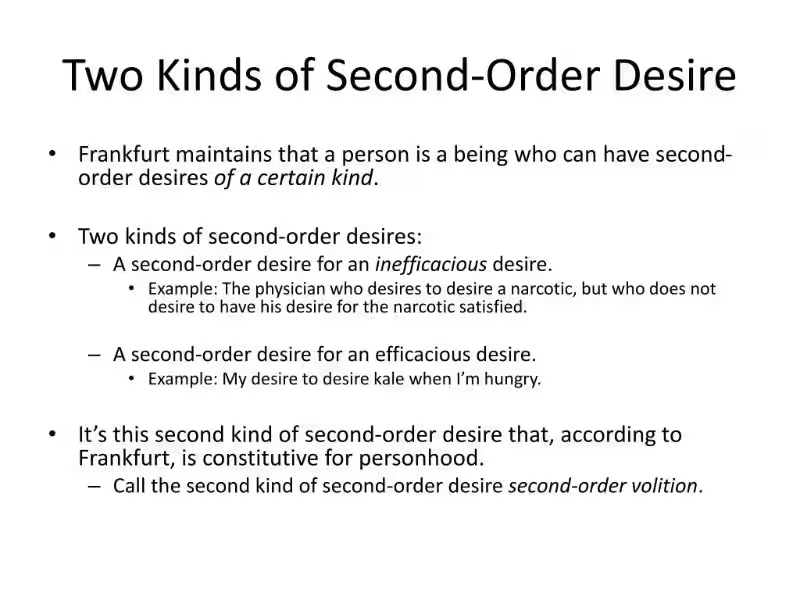
Second-order desires, on the other hand, are desires about our first-order desires. They represent a higher level of reflection. We might desire to have a particular first-order desire, or we might desire not to have it. This internal struggle, this desire about our desires, forms the crux of Frankfurt's argument. Crucially, not all desires are acted upon; many are just potential inclinations.
The Role of Second-Order Volitions
A critical component of second-order desires is the concept of second-order volitions. These are the specific kinds of second-order desires that matter in the context of free will. They are desires about which first-order effective desires (those that actually motivate action) we want to have. In simpler terms, they are desires about the desires that guide our actions. This hierarchical structure, where second-order volitions govern first-order desires, is the hallmark of a person, according to Frankfurt.
A crucial distinction emerges here between persons and what Frankfurt termed "wantons." Wantons, essentially non-persons, lack these second-order volitions. Their actions are driven solely by their first-order desires, without any critical evaluation or self-control.
Free Will and the Hierarchical Structure
Frankfurt's theory argues that free will is intricately linked to the presence of second-order volitions. Imagine a scenario where someone wants to quit smoking (a first-order desire), but constantly succumbs to cravings (another first-order desire). This person lacks free will because their will – their first-order effective desires – is not what they want it to be. They are ruled by a desire they don't endorse at a deeper level.
On the other hand, a person who consciously chooses to engage in a behavior, even if it is not their preferred option, still demonstrates free will if that action aligns with their second-order volitions. This individual actively chooses their desires, making them the authors of their action. They have free will because their will – the effective desires that shape their behavior – aligns with their second-order volitions.
Illustrative Examples: Understanding the Distinction
Understanding this distinction becomes clearer through examples. Frankfurt uses the analogy of an unwilling addict and a willing addict to illustrate the difference between wantons and persons.
-
Unwilling Addicts: These individuals have a first-order desire to abstain from drugs, but their first-order effective desires are overwhelmed by the urge to use. They lack free will because their will is not what they want.
-
Wanton Addicts: These individuals simply don't care which desire wins. They lack any second-order volitions and are merely driven by their immediate cravings. Their lack of free will is a result of their complete lack of self-control and self-reflection.
-
Willing Addicts: These people desire their first-order desire to take drugs to be effective. This aligns with their second-order volitions, meaning they want their will. They have free will, even if their actions aren't aligned with what some might consider morally sound.
Through these examples, Frankfurt highlights the crucial role of second-order desires in defining free will. It's not just about the action itself, but about the person's relationship to the desires that drive that action. A person's free will depends on their ability to actively choose and shape their own desires, a process fundamentally governed by their second-order volitions.
Implications and Further Considerations
Frankfurt's theory has significant implications for our understanding of free will. It suggests that free will isn't just about the freedom of action, but also about the alignment of our will with our desires about our desires. This intricate system illuminates the complexities of human agency.
It also raises questions about the nature of our desires and how they interact. Why do some desires persist despite our attempts to resist them? How do these desires evolve and change over time?
Further research could explore the interplay between second-order desires and various psychological factors, such as addiction, mental illness, and personal development, offering insights into the mechanisms underlying human behavior and decision-making. This could lead to a deeper understanding of what motivates our choices and how we can strive for greater self-control.
This exploration of second-order desires provides a unique lens through which to view human agency. It emphasizes the crucial role of self-reflection and self-control in shaping our choices and actions, highlighting the intricate interplay between our desires and our desires about those desires. This framework allows us to appreciate the complexities of human motivation and the role of free will in shaping our lives.
What are Second-Order Desires?
Second-order desires, a concept central to Harry Frankfurt's theory of free will, are desires about other desires. Essentially, they are desires concerning what your first-order desires should be. A first-order desire is a basic desire to act, like wanting a cookie. A second-order desire is about whether or not you want that cookie-related desire to be the one that guides your actions.
What is the Difference Between First-Order and Second-Order Desires?
First-order desires are the basic, immediate wants or needs that drive our actions. Second-order desires are desires about those first-order desires. They are desires to want or not want certain things. For example, you might have a first-order desire for pizza (want to eat pizza). A second-order desire would be about whether you want that desire for pizza to be what motivates your actions (want to want pizza).
What are Second-Order Volitions?
Second-order volitions are a specific type of second-order desire. They are desires about which of your first-order effective desires (the ones that actually motivate your actions) you want to be dominant. In other words, they are desires about what you want to want. A second-order volition is about controlling your will.
What is the Role of Second-Order Volitions in Free Will?
Frankfurt argues that the presence of second-order volitions is crucial for free will. Persons, unlike wantons (non-persons), possess these desires, which allow them to reflect on and regulate their first-order desires. This regulation is what distinguishes a person's choices as being freely chosen, rather than simply driven by whatever desires happen to be strongest at any given moment.
How Does Frankfurt's Theory Explain the Value of Free Will?
Frankfurt's theory explains why we value free will. It posits that free will is about aligning our first-order effective desires with our second-order volitions. We value the ability to choose which desires take hold because this alignment reflects a degree of control and ownership over our actions.
What is the Difference Between Persons and Wantons?
Persons, according to Frankfurt, have second-order volitions. They can reflect on their desires and choose which ones to act upon. Wantons, on the other hand, lack these higher-order desires. Their actions are simply determined by whichever first-order desires happen to be strongest. This distinction is key because it explains why we attribute free will to humans but not to animals.
How Does Frankfurt's Theory Relate to Determinism?
Frankfurt's theory is compatible with both deterministic and indeterministic views of the world. The presence or absence of second-order volitions, and thus free will, is not dependent on whether or not our actions are predetermined.
Does Frankfurt's Concept of "Want to" Have Specific Meanings?
Frankfurt acknowledges the ambiguity of the term "want to." He clarifies that not all wants are effective. A person can want something without that want actually manifesting in action. This distinction is important for understanding the nuances of desire and volition.