
Understanding and Utilizing a Population Equivalent Table
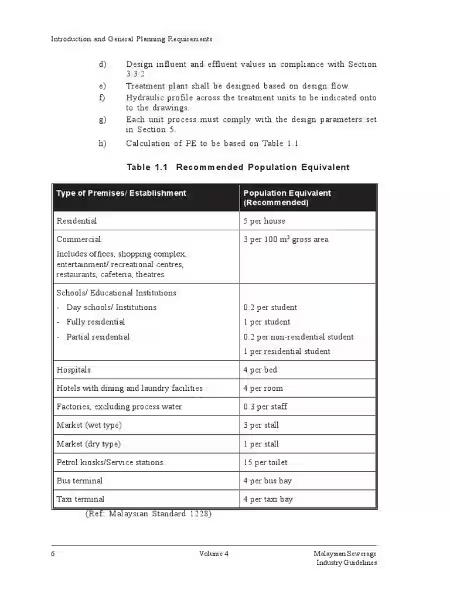
Have you ever wondered how wastewater treatment plants, or even smaller systems, determine their capacity and design? The answer often lies in a crucial tool: the population equivalent table. This table is essential for sizing wastewater treatment infrastructure, ensuring efficient and effective operation, and complying with environmental regulations. This article will demystify the population equivalent table, explaining its purpose, construction, and application.
- What is a Population Equivalent Table?
- Defining the Population Equivalent (PE)
- Components of a Population Equivalent Table
- Constructing a Population Equivalent Table
- Applications of a Population Equivalent Table
-
Frequently Asked Questions: Population Equivalent Tables
- What is a Population Equivalent (PE) Table?
- Why are Population Equivalent Tables Used?
- What factors are typically considered in a PE table?
- How is a Population Equivalent calculated?
- Are there standard PE values?
- Where can I find a PE table for my area?
- What are the limitations of using Population Equivalent Tables?
What is a Population Equivalent Table?
A population equivalent table is a crucial tool used in wastewater engineering to standardize the measurement of wastewater flow and pollutant loading. It translates different sources of wastewater into a common unit: the population equivalent (PE). Instead of dealing with complex flows and varying pollutant concentrations from diverse sources, engineers use a simplified metric that represents the amount of wastewater and pollutants generated by a single person. This standardization greatly simplifies the design and operation of wastewater treatment systems.
This simplification allows for easier comparison of different wastewater sources and their impacts on treatment facilities. For instance, a large factory might generate a significant wastewater flow, but the PE table allows engineers to quantitatively compare the polluting load from the factory to that of a residential area.
Defining the Population Equivalent (PE)
The population equivalent (PE) is the fundamental unit in a population equivalent table. It's defined as the amount of wastewater and pollutants generated by one person per day. This includes both domestic wastewater from residential areas and wastewater from other sources, all translated into the equivalent wastewater load of a single person. The specific values for flow and pollutant loads in PE calculations can vary depending on factors like lifestyle, climate, and local regulations. These variations are accounted for in the development of a population equivalent table specific to a given region or project.
Therefore, a PE of 100 means that the wastewater flow and pollutant loading from a particular source is equivalent to that of 100 people. This allows for a straightforward comparison and calculation of the overall design capacity needed for the treatment plant.
Components of a Population Equivalent Table
A typical population equivalent table includes several key parameters:
- Wastewater Flow (in liters/day or gallons/day): This represents the volume of wastewater generated per person per day.
- Biochemical Oxygen Demand (BOD): A measure of the amount of oxygen consumed by microorganisms during the decomposition of organic matter in the wastewater. High BOD indicates high organic pollution.
- Chemical Oxygen Demand (COD): A broader measure of the amount of oxygen required to oxidize all organic and inorganic matter in the wastewater.
- Suspended Solids (SS): The total amount of solid material suspended in the wastewater.
- Nitrogen (N) and Phosphorus (P): Nutrients that can contribute to eutrophication (excessive growth of algae) in receiving water bodies.
Each parameter is expressed in terms of its contribution per PE. For instance, a table might show 150 liters/day for flow, 60 g/PE/day for BOD and so on. The precise values will vary depending on the context and assumptions made during the table's creation. A specific population equivalent table is often prepared for a particular project.
Constructing a Population Equivalent Table
Creating a population equivalent table requires careful consideration of several factors:
- Local Data: The table should be based on reliable data collected locally regarding wastewater generation patterns. This data is typically gathered through surveys, sampling, and flow measurements.
- Population Density and Lifestyle: High-density residential areas will have different flow and pollutant characteristics compared to low-density areas, or areas with different economic or socio-cultural profiles.
- Industrial Contributions: Industrial wastewater contributes significantly to the overall load on treatment facilities. The table must accurately account for the contribution of industrial discharge, often requiring separate calculations for each type of industry.
- Commercial Contributions: Similarly, commercial establishments (restaurants, hotels, etc.) generate wastewater with unique characteristics. These contributions also need to be carefully assessed and incorporated.
- Regulatory Requirements: Environmental regulations often set limits on pollutant discharges. These limits must be considered when constructing the table to ensure compliance.
Factors Influencing PE Values
The values used in a population equivalent table are not static; they can vary based on several factors:
- Climate: Warmer climates tend to lead to higher water consumption and therefore higher wastewater flow.
- Seasonality: Wastewater generation can fluctuate seasonally due to changes in water use patterns.
- Technological advancements: Improvements in water-saving appliances and technologies can affect the overall wastewater flow.
It's critical to acknowledge these variations when using the table and to ensure the table is regularly reviewed and updated.
Applications of a Population Equivalent Table
The population equivalent table finds widespread application in various aspects of wastewater management:
- Wastewater Treatment Plant Design: The table directly informs the sizing of treatment units. The total PE for a service area determines the capacity requirements for the treatment plant.
- Treatment Plant Upgrades: When upgrading an existing facility, the table helps determine the necessary expansion capacity.
- Cost Estimation: The PE values are directly linked to treatment costs, enabling accurate cost projections for new or upgraded facilities.
- Environmental Impact Assessment: The table is invaluable for assessing the potential environmental impacts of new developments or industrial projects on receiving water bodies.
- Regulatory Compliance: The table facilitates compliance with wastewater discharge regulations by providing a standardized way to report pollutant loads.
Example Scenario
Imagine a small town planning a new wastewater treatment plant. The town's population is 5,000, but it also includes a small industrial park generating wastewater. Using a population equivalent table, engineers can translate the industrial wastewater flow and pollutant loads into PE values. Adding these PE values to the residential PE (5,000 people), they can determine the total design capacity of the treatment plant in terms of PE, allowing them to select appropriate equipment and ensure the plant can effectively handle the combined wastewater load.
The population equivalent table is a powerful tool that simplifies the complex task of managing wastewater. By standardizing the measurement of wastewater flow and pollutant loads, it facilitates efficient design, operation, and environmental management of wastewater treatment systems. Understanding its construction and applications is crucial for anyone involved in water resources management and environmental engineering. The accuracy and reliability of a population equivalent table are paramount; regular review and updates based on the latest local data are essential to ensure its continued effectiveness.
Since I don't have access to the content of the document "Título," I cannot create an FAQ section specifically about its population equivalent table. However, I can create a general FAQ section about population equivalent tables based on common concepts and applications.
Frequently Asked Questions: Population Equivalent Tables
What is a Population Equivalent (PE) Table?
A Population Equivalent (PE) table is a tool used to estimate the wastewater loading from a variety of sources, expressed in terms of the equivalent wastewater generated by a single person. It translates the wastewater contribution of different activities or sources (e.g., residential, commercial, industrial) into a standardized unit, making it easier to calculate the total wastewater load for a community or area. This allows for consistent design of wastewater treatment plants and infrastructure.
Why are Population Equivalent Tables Used?
PE tables are crucial for wastewater management planning and design. They simplify the complex process of estimating wastewater flows from diverse sources. Instead of dealing with multiple units and varying characteristics, engineers can express all contributions in terms of PE, simplifying calculations for treatment plant sizing, pipe diameter selection, and overall infrastructure planning.
What factors are typically considered in a PE table?
A PE table typically considers various factors, including:
- Type of source: Residential, commercial (e.g., restaurants, offices), industrial (depending on the type of industry and its waste characteristics), institutional (schools, hospitals).
- Water consumption rates: Different sources have different water usage patterns that directly influence wastewater generation.
- Wastewater strength: The concentration of pollutants in wastewater varies significantly depending on the source. Some sources generate stronger wastewater than others (e.g., food processing plants compared to residential houses).
- Seasonal variations: Water usage and wastewater generation can fluctuate seasonally, influencing the design of treatment facilities.
How is a Population Equivalent calculated?
A population equivalent is calculated by dividing the biochemical oxygen demand (BOD) or other relevant pollutant load from a specific source by the BOD produced per person per day (a typical value is often used as a standard, but this can vary based on local conditions and studies). The formula is often something like: PE = (BOD of source)/(BOD per capita).
Are there standard PE values?
While some general values are commonly used, there are no universally standardized PE values. The values used in a PE table are highly context-dependent and should be based on local data and site-specific conditions. Factors such as climate, lifestyle, and industrial processes significantly influence the actual wastewater generation.
Where can I find a PE table for my area?
PE tables are often developed by local or regional authorities responsible for wastewater management. They may be found in local government documents, engineering design standards, or through consulting with environmental engineering firms specializing in wastewater treatment. You would likely need to consult local regulations and guidelines relevant to your specific region.
What are the limitations of using Population Equivalent Tables?
PE tables provide a simplified representation of a complex system. They may not always accurately reflect the actual wastewater characteristics or flow variations. For highly variable or unusual sources, more detailed analysis and modeling may be necessary. Furthermore, the underlying assumptions used to develop the table should be carefully considered.