
Finding Your Way to the Los Angeles Asylum Office
Many individuals seeking asylum in the United States have questions about the Los Angeles Asylum Office. This article aims to clarify the office's location, accessibility, and what services it does and does not provide. It's crucial to understand that while this office plays a role in the asylum process, it's not the place to submit your application.
- Location and Accessibility of the Los Angeles Asylum Office
- Understanding the Role of the Los Angeles Asylum Office
-
The Importance of Community Partnerships
- Improving Access to Information
- Enhancing Application Quality
- Increasing Efficiency
- Facilitating Societal Integration
- Where is the Los Angeles Asylum Office located?
- How can I get to the Los Angeles Asylum Office by car?
- How can I get to the Los Angeles Asylum Office using public transportation?
- Is the Los Angeles Asylum Office accessible to individuals with disabilities?
- Can I submit my asylum application (Form I-589) or NACARA 203 application (Form I-881) at the Los Angeles Asylum Office?
- What services does the Los Angeles Asylum Office provide?
- Does the Los Angeles Asylum Office offer any assistance in completing my application?
- What is the role of community partnerships in the work of the Los Angeles Asylum Office?
Location and Accessibility of the Los Angeles Asylum Office
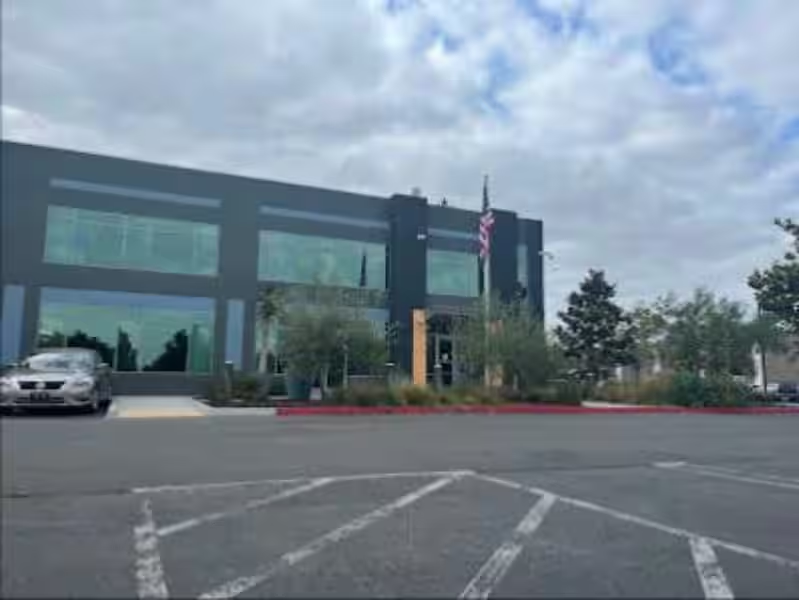
The Los Angeles Asylum Office is situated at 14101 Myford Road, serving a vast geographical area. This includes parts of several states: California (Imperial, Los Angeles, Orange, Riverside, San Bernardino, San Diego, San Luis Obispo, Santa Barbara, and Ventura counties), Arizona, Hawaii, Nevada (Clark, Esmeralda, Lincoln, and Nye counties), and Guam.
The office provides detailed instructions for reaching it by car, both using the 5 Freeway and surface streets. Driving directions from the 5 Freeway (exit 100, Jamboree Road) involve straightforward turns onto Jamboree Road, Michelle Drive, and finally Myford Road. Alternatively, using surface streets, you should head north on Myford Road.
The office also considers public transportation accessibility. While the nearest train station, the Metrolink station at 2975 Edinger Ave in Tustin, CA 92780, is accessible via the Orange County Transit Authority (OCTA, www.OCTA.net), specific bus routes require further independent research via the OCTA website.
On-site parking is available, and the building is designed to be accessible to individuals with disabilities.
What the Los Angeles Asylum Office Does NOT Do
It is absolutely crucial to understand that the Los Angeles Asylum Office itself does not accept asylum applications (Form I-589) or NACARA 203 applications (Form I-881). Do not attempt to submit your application to this address.
You will find yourself wasting valuable time, possibly missing deadlines, and potentially jeopardizing your case. Instead, always refer to the official USCIS website for the correct filing location and procedure instructions.
- Find instructions for Form I-589 (Asylum Application) at: https://www.uscis.gov/i-589
- Find instructions for Form I-881 (Application for Suspension of Deportation or Special Rule Cancellation of Removal) at: https://www.uscis.gov/i-881
Understanding the Role of the Los Angeles Asylum Office
While the office doesn't process applications directly, its role within the broader USCIS structure is significant. The office's function is to facilitate the overall asylum process indirectly by coordinating with other agencies and partners.
The seemingly simple task of ensuring the correct submission of forms is critical in the asylum process; wrong submissions can lead to delays and complications. The Los Angeles Asylum Office's location, accessibility information, and clear guidance on where to file applications are all important parts of a functioning system.
The physical presence of the office establishes a point of contact and legitimacy within the community for asylum seekers, offering a tangible connection to the process. This can significantly reduce anxiety and confusion for individuals navigating a complex and often daunting system.
The Importance of Community Partnerships
The USCIS Los Angeles Asylum Office actively engages in community partnerships to enhance its effectiveness and better serve asylum seekers. These partnerships are vital because they bridge the gap between the formal USCIS processes and the practical realities faced by individuals seeking asylum.
Improving Access to Information
One key area of focus is improving access to information. Partnerships with non-governmental organizations (NGOs) and community-based organizations (CBOs) ensure accurate and up-to-date information reaches asylum seekers, many of whom are unfamiliar with the US immigration system. These organizations often provide crucial translation services and outreach to underserved communities. This ensures critical information is understood and accessible regardless of language barriers or other challenges.
Enhancing Application Quality
Collaboration with legal service providers and NGOs enhances the quality of asylum applications. Legal assistance helps ensure applications are comprehensive and well-supported, leading to more efficient processing and potentially better outcomes for applicants. These partnerships also help identify and address gaps in legal representation, promoting fairer access to justice.
Increasing Efficiency
Streamlined communication and shared resources between USCIS and its partners contribute to a more efficient asylum process. Reducing processing times and bureaucratic hurdles reduces stress and uncertainty for applicants during a challenging time.
Facilitating Societal Integration
Finally, community partnerships address broader societal integration needs. Many organizations involved provide crucial support services such as housing, healthcare, and language training. By working with these organizations, USCIS indirectly supports the successful integration of asylum seekers into American society, fostering economic and social self-sufficiency.
In conclusion, the Los Angeles Asylum Office, while not directly handling application submissions, plays a crucial role in the overall asylum process. Its physical presence, accessibility initiatives, and proactive community partnerships are vital for creating a more supportive, efficient, and equitable system for asylum seekers. Remember to always consult the official USCIS website for the most accurate and up-to-date information regarding application procedures and filing locations.
Where is the Los Angeles Asylum Office located?
The Los Angeles Asylum Office is located at 14101 Myford Road, Irvine, CA. It serves individuals seeking asylum in Arizona, California (Imperial, Los Angeles, Orange, Riverside, San Bernardino, San Diego, San Luis Obispo, Santa Barbara, and Ventura counties), Hawaii, Nevada (Clark, Esmeralda, Lincoln, and Nye counties), and Guam.
How can I get to the Los Angeles Asylum Office by car?
Driving directions are available from both the North and South on the 5 Freeway (exit 100, Jamboree Road). Detailed instructions involving turns onto Jamboree Road, Michelle Drive, and Myford Road are available directly from the office (though these are not provided here). Surface street directions using Myford Road are also available. On-site parking is available.
How can I get to the Los Angeles Asylum Office using public transportation?
The nearest train station is the Metrolink station at 2975 Edinger Ave, Tustin, CA 92780. You can then use the Orange County Transit Authority (OCTA, www.OCTA.net) for further transport; however, specific bus routes are not detailed here.
Is the Los Angeles Asylum Office accessible to individuals with disabilities?
Yes, the Los Angeles Asylum Office is accessible to individuals with disabilities.
Can I submit my asylum application (Form I-589) or NACARA 203 application (Form I-881) at the Los Angeles Asylum Office?
No. The Los Angeles Asylum Office does not accept asylum applications (Form I-589) or NACARA 203 applications (Form I-881). You must submit these forms according to the instructions on the USCIS website:
- Form I-589: https://www.uscis.gov/i-589
- Form I-881: https://www.uscis.gov/i-881
Please carefully review the USCIS website for the correct filing location and procedures before submitting your application.
What services does the Los Angeles Asylum Office provide?
The provided information focuses primarily on the office's location and accessibility. Details regarding specific case services and accommodations are not available in this resource. For information about case services, please contact USCIS directly or consult their website.
Does the Los Angeles Asylum Office offer any assistance in completing my application?
The Los Angeles Asylum Office itself does not provide assistance in completing your application. However, they foster community partnerships with organizations that may offer legal aid and support. For assistance with your application, consider seeking help from non-governmental organizations (NGOs) or community-based organizations (CBOs) in your area.
What is the role of community partnerships in the work of the Los Angeles Asylum Office?
The Los Angeles Asylum Office actively works with community partners (NGOs and CBOs) to improve information access for asylum seekers, enhance application quality through legal assistance, increase efficiency in the asylum process and support broader societal integration through services like housing and language training.