
FLETC Use of Force: Navigating the Legal and Practical Landscape
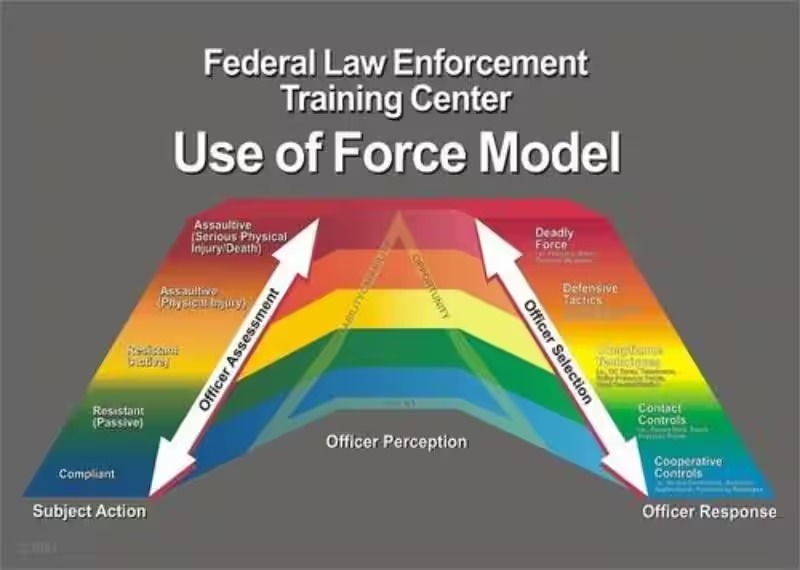
This article delves into the critical issue of use-of-force training, specifically highlighting the role of Federal Law Enforcement Training Centers (FLETC) in equipping officers with the knowledge and skills necessary for making legally sound decisions under pressure. It's crucial for law enforcement to understand the legal framework and practical applications surrounding use-of-force, especially given the complex interactions that often lead to these situations.
- Understanding the Legal Framework: The Fourth Amendment and Graham v. Connor
- FLETC's Comprehensive Use of Force Training
- Ongoing Training and Instructor Development
-
FLETC Use of Force Training FAQ
- What is the legal standard for use of force during a law enforcement encounter?
- What factors are considered when determining the reasonableness of force?
- How is factual detail relevant to demonstrating the reasonableness of force?
- What is the role of "cop talk" and subjective interpretations in use-of-force incidents?
- How does FLETC address the potential for memory distortion and stress during high-pressure situations?
- What is the difference between legal standards and agency policies regarding use of force?
- How does FLETC's use-of-force training program develop practical application skills?
- What is the role of the FLETC Use of Force Instructor Training Program (UOFITP)?
Understanding the Legal Framework: The Fourth Amendment and Graham v. Connor
The Fourth Amendment of the U.S. Constitution protects against unreasonable searches and seizures. This protection directly impacts the use of force during law enforcement encounters. The Supreme Court's landmark decision in Graham v. Connor solidified the concept of "objective reasonableness" as the touchstone for evaluating the use of force. This means that any use of force, whether deadly or not, must be objectively reasonable, judged from the perspective of a reasonable officer on the scene, considering the totality of the circumstances. Subjective beliefs or opinions of the officer are irrelevant. A critical factor in this process is the importance of clear and factual reporting.
This objective standard emphasizes the importance of factual detail in demonstrating reasonableness. An officer's ability to clearly articulate the circumstances surrounding a use-of-force incident is paramount in determining whether their actions were justified. The focus shifts from the officer's subjective interpretation to the concrete facts observable at the time of the incident. The key is to paint a picture of the situation, using precise and descriptive language to avoid ambiguity. This doesn't require being a forensic detailer, but rather focusing on detailed observations.
The Importance of Factual Reporting
The Graham v. Connor decision underscores the importance of detailed and specific factual reporting. Vague language, often used in "cop talk," is insufficient. Terms like "non-compliant" or "suspicious movements" are inherently subjective and don't provide the concrete details necessary for an objective assessment. Instead, officers should describe specific actions, behaviors, and physical indicators. For example, instead of "non-compliant," officers should state "suspect refused to place hands behind his back." Detailed descriptions of physical cues, like glassy eyes or slurred speech, are critical in building a complete picture of the encounter.
Using concrete examples, officers should describe the suspect's actions with clear, active verbs and sensory details. Every aspect of the scene should be recorded, from the suspect's demeanor to the environment. Avoid implying or suggesting actions, instead stating the actions that were observed. This meticulous approach ensures a clear and accurate record of the incident, making it easier to establish the objective reasonableness of the force used.
Beyond the "How" and "Why"
Many use-of-force incidents involve the use of subjective language. Statements like, "The suspect was acting suspiciously" or "I felt threatened" fail to provide the necessary concrete data for a legal evaluation. The focus should be on the observable actions and behaviors, not on the officer's interpretation of those actions. The "how" and "why" are often irrelevant. The "what" – the specifics – is what matters. This crucial aspect of precise language differentiates between a good report and a poor one.
FLETC's Comprehensive Use of Force Training
FLETC's use-of-force training program recognizes the vital link between legal standards and practical application. The training begins with a thorough legal foundation, emphasizing the Graham v. Connor standard of objective reasonableness. This crucial two-hour component focuses on the legal framework and its impact on use-of-force decisions.
The training emphasizes the importance of precise reporting in use-of-force incidents. Recognizing that training is not just about physical skills but also about understanding the legal framework behind those skills, instructors guide students to articulate the factual basis for their actions using specific details and observations.
Practical Application and Human Performance Factors
Following the legal component, practical training is reinforced through hands-on scenarios. This component emphasizes the range of reasonable force options. FLETC instructors provide examples of both excessive and insufficient force responses. The training is designed to recognize and acknowledge the significant impact of "human performance factors" on officer decision-making.
FLETC incorporates stress-induced sensory distortions that affect recall and judgment into training scenarios. This is crucial because officers often face high-pressure situations in real-world scenarios. The training acknowledges the potential for memory distortion under stress but underscores the importance of accurately documenting events as they unfold.
From Fragmentation to Interactive Scenarios
The training progresses through various scenarios, starting with highly structured "fragmentation drills" that focus on specific reactions to basic facts. These drills gradually progress to more open-ended scenarios requiring students to use judgment and select appropriate force options based on perceived threat. Finally, the training culminates in fully interactive scenarios, such as executing an arrest warrant, demanding a complete application of learned principles. After each scenario, students justify their chosen force options, encouraging critical thinking and self-assessment.
Ongoing Training and Instructor Development
FLETC understands that effective use-of-force training is an ongoing process, requiring continuous development for instructors. The Use of Force Instructor Training Program (UOFITP) provides advanced training to current and future instructors. This intensive, two-week program equips participants with a deep understanding of both the legal and practical aspects of use-of-force, enabling them to effectively impart this knowledge to others. The program reinforces the cyclical process of knowledge transfer within law enforcement, ensuring a continuous improvement in use-of-force training. This comprehensive approach ensures that officers are not only trained but also equipped to make informed decisions in high-pressure situations, upholding the principles of the Fourth Amendment in the field.
FLETC Use of Force Training FAQ
What is the legal standard for use of force during a law enforcement encounter?
The legal standard for use of force is "objective reasonableness," as defined by the Supreme Court's Graham v. Connor decision. This means that any force used, whether deadly or not, must be objectively reasonable based on the totality of the circumstances as perceived by a reasonable officer on the scene, not with the benefit of hindsight. Subjective beliefs or opinions of the officer are not relevant.
What factors are considered when determining the reasonableness of force?
The reasonableness of a seizure, including any use of force, is judged based on the inception of the encounter, and the degree and duration of force employed. Crucial factors include, but are not limited to: the specific details of the situation, the officer's observations, and the suspect's behavior.
How is factual detail relevant to demonstrating the reasonableness of force?
Detailed, specific factual reporting is critical. Officers must provide concrete descriptions using active verbs and sensory details, rather than vague terms. This includes describing actions, physical indicators (glassy eyes, slurred speech), and the suspect's behavior (e.g., "suspect refused to comply with commands," "suspect reached under the seat").
What is the role of "cop talk" and subjective interpretations in use-of-force incidents?
Subjective interpretations and "cop talk" are problematic because they lack the factual grounding needed for an objective legal assessment. Vague terms ("non-compliant," "furtive movement," "indicated") should be avoided in favor of precise descriptions of observable actions and details.
How does FLETC address the potential for memory distortion and stress during high-pressure situations?
FLETC training acknowledges the impact of stress and memory distortion. While perfect recall isn't always possible, officers are still required to document the encounter accurately, describing the overall tone, demeanor, and actions of the individuals involved, even if exact words cannot be recalled.
What is the difference between legal standards and agency policies regarding use of force?
FLETC training emphasizes that while agency policies may guide officers, courts rely on the Fourth Amendment's "objective reasonableness" standard, as articulated in Graham v. Connor.
How does FLETC's use-of-force training program develop practical application skills?
Training progresses from structured drills to more complex scenarios, culminating in interactive scenarios such as executing arrest warrants. Following each scenario, students justify their use-of-force decisions. This process reinforces the application of legal principles and appropriate force options.
What is the role of the FLETC Use of Force Instructor Training Program (UOFITP)?
The UOFITP trains instructors to effectively teach use-of-force techniques to law enforcement officers. This cyclical process of knowledge transfer ensures continued quality and effectiveness in the field.