
What is the Difference Between Ethnic and Religious Groups?
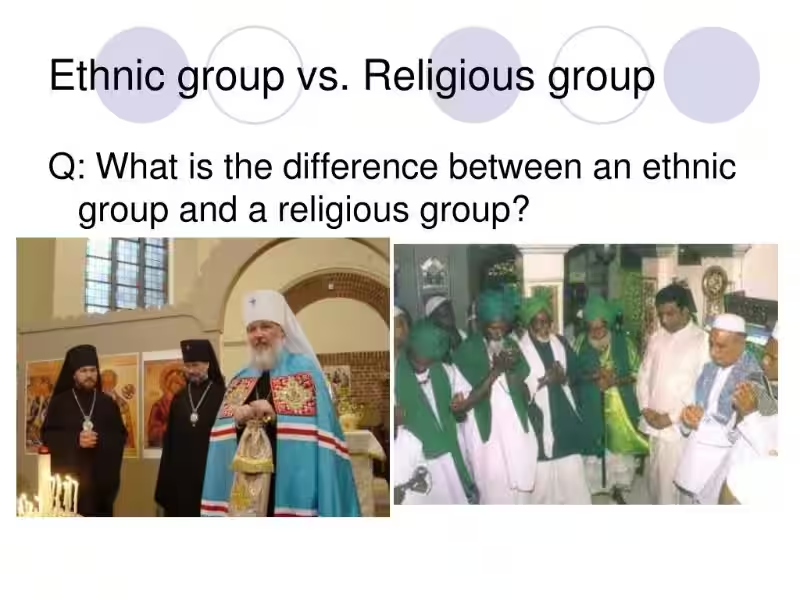
Understanding the distinctions between ethnic and religious groups is crucial for comprehending societal dynamics and individual identities. While often intertwined, these concepts possess unique characteristics and influences. This article delves into the nuances of ethnicity and religion, exploring their differences and the multifaceted relationships they share.
- Defining Ethnic Groups
- Defining Religious Groups
- The Intersection of Ethnicity and Religion
- What is the Difference Between Ethnic and Religious Groups? A Summary
-
FAQ: Ethnicity vs. Religious Groups
- What is the difference between ethnicity and religion?
- Are ethnicity and religion always linked?
- How do sociologists explain the relationship between ethnicity and religious practice?
- Can you give examples of how ethnicity and religion can be distinct?
- How might socioeconomic factors influence the relationship between ethnicity and religion?
- What are the potential biases in studying the relationship between ethnicity and religion?
- How does cultural transition theory explain changing levels of religious observance in immigrant communities?
- Does the level of religious practice vary across different ethnic groups?
- How can the different perspectives on ethnicity and religion help us understand the issue better?
- What is the sociological definition of ethnicity?
- What is the role of ethnic enclaves in immigrant communities?
- How does ethnicity play a role in social interactions?
- How does ethnicity influence cultural expression?
- What is "symbolic ethnicity"?
- How does the concept of ethnicity differ from race?
- How do racial and ethnic categories intersect?
- What are the implications of ethnicity in different contexts (census, affirmative action)?
- How might ethnicity be a factor in conflict?
Defining Ethnic Groups
An ethnic group is a social group that shares common cultural or historical experiences, including ancestry, language, traditions, and values. These shared experiences create a sense of collective identity and belonging. This shared heritage shapes beliefs, lifestyles, and worldviews for members of the group. The defining features of an ethnic group are social constructs, not biological ones. For example, shared ancestry, language, and traditions create a sense of unity within the group, forming a collective identity. An ethnic group exists when individuals have a common cultural heritage and a sense of belonging to that group.
Key Characteristics of Ethnic Groups
- Shared Culture: This includes aspects such as language, customs, traditions, and values.
- Sense of Belonging: Members of an ethnic group often feel a strong connection to each other and a sense of shared history and identity.
- Social Construct: Ethnicity is not based on biological traits, but rather on shared social and cultural experiences.
- Diversity within Unity: Ethnic groups often include variations in their members' experiences due to differing socioeconomic factors, geographic location, or profession.
Defining Religious Groups
A religious group, on the other hand, is characterized by a shared set of beliefs, practices, and values centered around a particular faith or spirituality. These beliefs often involve rituals, doctrines, and moral codes that guide members' lives. Religious groups can be diverse in their practices and interpretations of their faith. A religious affiliation influences a person's worldview, ethical compass, and daily habits.
Key Characteristics of Religious Groups
- Shared Beliefs: A core set of religious tenets, doctrines, and interpretations guide members' lives.
- Rituals and Practices: Religious groups often engage in specific rituals, ceremonies, and practices to express their faith.
- Moral Codes: Religious beliefs often provide a framework for ethical conduct and moral principles.
- Spiritual Community: Membership in a religious group creates a sense of community and belonging based on shared faith and practices.
The Intersection of Ethnicity and Religion
The relationship between ethnicity and religious involvement is complex and multifaceted. The two are not mutually exclusive, and often overlap significantly. For example, certain ethnic groups may exhibit a higher level of religious practice than others. This difference may stem from cultural factors, historical events, or socioeconomic conditions. It is crucial to recognize that this relationship is not homogenous. For instance, while religious observance may be prevalent in certain ethnic communities, there's a wide range of religious practices within those groups.
Complex Interplay
- Cultural Defense: In some cases, religion serves as a cultural defense mechanism, offering a sense of belonging and cultural preservation for members facing societal hostility or marginalization.
- Cultural Transition: As ethnic groups integrate into a new society, their religious practices may evolve or change, potentially decreasing the fervor of religious involvement as generations transition.
- Socioeconomic Factors: Religion can offer solace and guidance during hardship, particularly for marginalized ethnic minorities facing socioeconomic challenges.
- Religious Institutions as Platforms for Social Change: In some contexts, religious institutions act as platforms for collective action and advocacy for marginalized ethnic groups, though this is not universally applicable.
What is the Difference Between Ethnic and Religious Groups? A Summary
Key Distinctions:
- Ethnicity focuses on shared cultural, historical, and ancestral experiences, forming a collective identity.
- Religion centers on shared beliefs, practices, and values related to a particular faith.
Overlapping Influences:
- Cultural Defense: Religion can provide a sense of community and cultural preservation, especially for marginalized groups.
- Cultural Transition: Religious practices may evolve as an ethnic group integrates into a new society.
- Socioeconomic Factors: Religion can offer support and guidance in times of hardship, particularly for marginalized communities.
- Social Change: Religious institutions can offer platforms for advocacy and collective action for marginalized groups.
The Importance of Context:
- Religious practices vary significantly within ethnic groups, and the relationship between ethnicity and religious involvement is context-dependent.
- Understanding the intricacies of the relationship requires careful consideration of factors such as history, socioeconomic conditions, and cultural adaptations.
Further Considerations:
- Self-reporting biases: Surveying religious practice requires caution due to potential inaccuracies in self-reporting.
- Institutional exaggeration: Data on religious affiliation can be affected by institutional exaggeration of membership numbers.
- Diversity within groups: There is significant diversity within both ethnic and religious groups, and generalizations should be avoided.
- Symbolic ethnicity: Individuals may embrace superficial aspects of their ethnic heritage without a profound connection to the culture.
- Intersectionality: Identity is complex and intersectional; individuals may belong to multiple ethnic and religious groups simultaneously.
By acknowledging the nuanced differences and interconnectedness between ethnic and religious groups, we gain a richer understanding of societal dynamics and individual identities. It is crucial to avoid making generalizations or stereotypes about these groups. Approaching these topics with sensitivity and respect for cultural diversity is paramount. This careful approach allows for a more nuanced and informative discussion of these essential concepts.
20 Most Relevant Points (Summarized):
- Ethnicity is a social construct, not biological.
- Religion centers on shared beliefs and practices.
- Shared cultural experiences define ethnic groups.
- Shared faith defines religious groups.
- Ethnicity and religion often overlap.
- Cultural defense theory explains the link between ethnicity and religion.
- Cultural transition theory describes evolving religious practices.
- Socioeconomic factors influence religious practice.
- Religious institutions can be platforms for social change.
- Data on religious practice requires caution.
- Self-reporting and institutional biases exist.
- Diversity exists within both ethnic and religious groups.
- Symbolic ethnicity is a superficial embrace of heritage.
- Identities are complex and intersectional.
- Ethnicity shapes individual and group identities.
- Religion shapes individual and group identities.
- Context is critical for understanding the relationship.
- Avoid generalizations and stereotypes.
- Approach topics with sensitivity.
- Recognize the nuances of ethnicity and religion.
FAQ: Ethnicity vs. Religious Groups
This FAQ section addresses the differences between ethnic and religious groups, drawing on sociological perspectives and avoiding plagiarism.
What is the difference between ethnicity and religion?
Ethnicity encompasses shared cultural, linguistic, and ancestral heritage, forming a sense of collective identity. Religion, on the other hand, represents a specific belief system and practice. While often intertwined, they are distinct concepts. An individual's ethnicity is not determined by their religious affiliation.
Are ethnicity and religion always linked?
No, ethnicity and religion are not always linked. While some ethnic groups may share religious traditions, many individuals maintain cultural heritage without aligning with a particular religion. Similarly, individuals with shared religious beliefs may not share an ethnic background.
How do sociologists explain the relationship between ethnicity and religious practice?
Sociological theories propose various explanations for the relationship between ethnicity and religious practice. "Cultural defense" theory suggests that religion can provide a sense of belonging and cultural preservation in a new, potentially hostile environment. "Cultural transition" theory proposes that religious practice may decrease as communities integrate into a new society. Weber's perspective links religiosity to socioeconomic factors, suggesting that religion can offer solace and guidance during hardship. Other perspectives, like neo-Marxist interpretations, emphasize the potential role of religious institutions in resistance against exploitation and inequality.
Can you give examples of how ethnicity and religion can be distinct?
Yes. Jewish traditions are practiced by individuals with diverse ethnic backgrounds. Similarly, individuals may identify with an ethnic group without adhering to any particular religion.
How might socioeconomic factors influence the relationship between ethnicity and religion?
Socioeconomic factors, such as poverty and discrimination, can influence the importance of religion within an ethnic group. Religion can serve as a source of support and community in challenging conditions.
What are the potential biases in studying the relationship between ethnicity and religion?
Surveys and data collection methods can be prone to biases, such as self-reporting inaccuracies or institutional exaggeration of membership. Researchers must therefore interpret data cautiously to avoid oversimplification or misinterpretation.
How does cultural transition theory explain changing levels of religious observance in immigrant communities?
Cultural transition theory suggests that as immigrant communities become more integrated into a new society, religious observance may diminish. This is often observed in subsequent generations of immigrants.
Does the level of religious practice vary across different ethnic groups?
Studies show significant variations in levels of religious practice across different ethnic groups. Some groups demonstrate higher levels of religious observance than others, a pattern that is not always straightforward to explain.
How can the different perspectives on ethnicity and religion help us understand the issue better?
By considering various sociological perspectives, such as cultural defense, cultural transition, and Weberian views, we gain a more nuanced understanding of the complex interplay between ethnicity, socioeconomic factors, and religious practice. Recognizing the diversity within and across different ethnic and religious groups is crucial for a comprehensive understanding.
What is the sociological definition of ethnicity?
Ethnicity is a social construct based on shared social, cultural, and historical experiences. It’s not based on biological differences.
What is the role of ethnic enclaves in immigrant communities?
Ethnic enclaves provide support networks, maintain cultural practices, and often facilitate economic opportunities for immigrants. However, they can also pose potential barriers to assimilation into the mainstream society.
Ethnicity can significantly shape social interactions, both positively and negatively, but it isn't the only factor at play. Prejudice and conflict can arise between different ethnic groups, as observed throughout history and in contemporary society.
How does ethnicity influence cultural expression?
Ethnicity impacts lifestyle, physical development, and health. Differences in socioeconomic factors, professions, and geographic locations within an ethnic group can significantly influence how individuals express their ethnicity.
What is "symbolic ethnicity"?
Symbolic ethnicity is the phenomenon where individuals embrace superficial aspects of their ethnic heritage, such as specific foods or holidays, without a deeper connection to the culture.
How does the concept of ethnicity differ from race?
Ethnicity, unlike race, is a social construct, not a biological one. It's based on shared social, cultural, and historical experiences, not perceived biological traits.
How do racial and ethnic categories intersect?
Racial and ethnic categories often overlap and intersect in complex ways. For example, individuals may be categorized as "white" racially but have distinct ethnic identities, while a single British ethnic group may include people from various racial backgrounds.
What are the implications of ethnicity in different contexts (census, affirmative action)?
Ethnicity plays a significant role in many aspects of life, including the census, affirmative action policies, and everyday social interactions. Understanding its nuances is essential for equitable and just practices.
How might ethnicity be a factor in conflict?
Ethnicity, when misused or exaggerated, can be a source of conflict between different groups. This can be seen both historically and in contemporary society.