
Issue Brief Sample: Defining Value in Healthcare Delivery
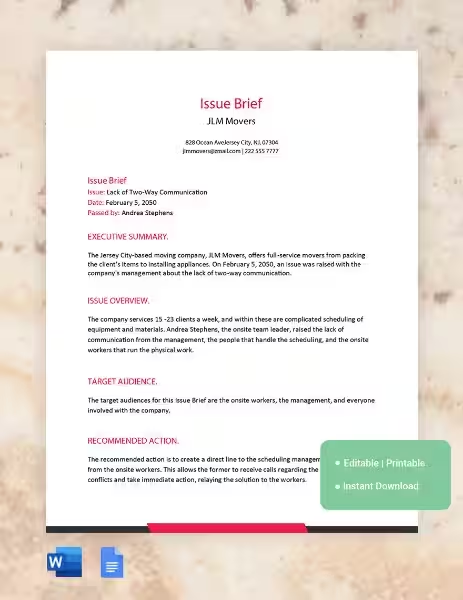
Is a universally accepted definition of "value" in healthcare even possible? This issue brief probes the complexities surrounding this critical concept. The lack of a standardized definition presents significant challenges for healthcare reform. This article will guide you through the key elements of a well-structured issue brief, using the concept of value in healthcare as a practical example.
- Understanding the Core Components of an Issue Brief
- Defining the "Issue": The Value Conundrum
- The "Recommendation" Section: A Proposed Solution
- Analyzing "Current Law" and Existing Frameworks
- The "Background" Section: Supporting the Argument
- Leveraging "References/Resources": Credibility and Transparency
- "Contact Information": Encouraging Dialogue
- 20 Most Relevant Points Summarized from the Issue Brief Sample:
-
Issue Brief FAQ
- What is an Issue Brief?
- What are the key components of an Issue Brief?
- Why is brevity important in an Issue Brief?
- What is the purpose of the "Recommendation" section?
- How does the "Background" section support the argument?
- How is the "References/Resources" section crucial for credibility?
- What is the role of "Contact Information"?
- How can I use an issue brief internally?
- How can I use an issue brief externally?
- Example Issue Brief: Defining Value in Healthcare
Understanding the Core Components of an Issue Brief
An issue brief, a concise document for presenting a policy issue, is a powerful tool for advocacy. Its effectiveness hinges on brevity and clear communication. For internal use, an issue brief should align with the organization's policies and agenda. An issue brief sample, like the one presented here, must articulate a problem, propose a solution, and provide supporting evidence.
This structured approach is crucial for a focused argument. A well-written issue brief isn't just a collection of facts; it's a persuasive narrative that moves towards a specific recommendation. Clear organization and concise language are essential to its success. A successful issue brief avoids ambiguity and presents a clear path forward for stakeholders.
Defining the "Issue": The Value Conundrum
The issue of value in healthcare delivery is multifaceted and lacks a universal definition. This lack of clarity impacts decision-making across the entire healthcare spectrum. Different stakeholders – providers, payers, patients – hold different perspectives, often leading to conflicting priorities. Providers often focus on quality of care and outcomes, while payers prioritize cost-effectiveness. Patients, conversely, may value access and personal experience. These diverging viewpoints hinder progress toward a unified understanding of healthcare value.
The inherent complexity of healthcare itself compounds the problem. The wide range of services, treatments, and patient needs makes it difficult to develop a single, universally applicable metric for measuring value. The interactions of economic, social, and ethical factors further complicate the issue. Uncertainties in patient outcomes add another layer of complexity.
The "Recommendation" Section: A Proposed Solution
A robust issue brief requires a clear recommendation. In this instance, the brief implicitly recommends a collaborative, multi-stakeholder approach to addressing the value conundrum. The American Hospital Association (AHA) is highlighted as a key organization aiming to address this issue. Their efforts suggest a commitment to creating a framework for defining and measuring value.
The recommendation implicitly suggests that a universally accepted definition is needed, achievable through consensus building involving providers, payers, patients, and policymakers. This collaborative approach is essential to synthesize varied perspectives into a single, robust framework for evaluating healthcare value.
Analyzing "Current Law" and Existing Frameworks
Current legal and regulatory frameworks may inadvertently support or contradict specific value propositions. Absent a clear legal framework defining value, this aspect of the issue brief is less detailed in this specific instance. However, a comprehensive issue brief on this subject would need to explore relevant laws and regulations to understand how they relate to various stakeholder perspectives on value. Legal frameworks can both guide and constrain approaches to defining and measuring value in healthcare.
The "Background" Section: Supporting the Argument
The background section is crucial for demonstrating the significance of the issue. The brief highlights the differing interpretations of value, emphasizing how providers, payers, and patients each weigh different factors. The background section should include relevant data, both qualitative and quantitative. This includes citations to reports, studies, and relevant organizational policies. In this example, the background section implicitly lays out the need for a comprehensive approach to defining value.
Leveraging "References/Resources": Credibility and Transparency
The references and resources section is essential for credibility. The brief alludes to the need for further study and research on the topic, implying that a detailed issue brief would cite relevant research and reports. Transparency in sourcing ensures that all claims are verifiable, crucial for building trust in the analysis and recommendation.
"Contact Information": Encouraging Dialogue
The brief implicitly encourages dialogue about defining value. The lack of explicit contact information underscores the need for broader engagement and discussion. A comprehensive issue brief would include the names, positions, and contact information of key stakeholders, enabling direct communication and collaboration.
20 Most Relevant Points Summarized from the Issue Brief Sample:
Defining Value in Healthcare:
- Value in healthcare lacks a universal definition.
- Stakeholders (providers, payers, patients) hold differing perspectives.
- Defining value is complex due to the multifaceted nature of healthcare.
- Economic, social, and ethical considerations are intertwined.
- Uncertainty surrounding patient outcomes adds complexity.
- Understanding limitations of existing definitions is crucial.
- A standardized definition is needed for effective healthcare reform.
- The AHA is striving to address the issue.
- A multi-stakeholder approach is crucial for a holistic understanding.
- This approach aims to synthesize various perspectives.
- Improved decision-making is a potential outcome.
- Creating more effective and equitable healthcare is a goal.
- The brief highlights the need for further research and analysis.
- Evidence-based arguments are essential.
- Transparency in sourcing is crucial for credibility.
- The issue brief implicitly advocates for a collaborative approach.
- Clear articulation of the issue is vital for advocacy.
- A clear recommendation is needed to guide future action.
- The brief implicitly suggests a multi-stakeholder approach is the solution.
- An issue brief sample on this subject would include relevant laws and regulations.
This concise summary highlights the crucial elements of a well-structured issue brief sample and demonstrates its application to a complex issue like the definition of value in healthcare.
Issue Brief FAQ
This FAQ section addresses common questions about issue briefs, using the provided context as a basis.
What is an Issue Brief?
An issue brief is a concise document presenting a specific policy issue, proposing a course of action, and supporting it with evidence. It's typically one page long and adheres to an organization's policies and agenda, if applicable. Its streamlined structure allows for clear communication and focused argumentation.
What are the key components of an Issue Brief?
An effective issue brief includes:
- Issue: A clear definition of the problem, its significance, and its relevance to the audience.
- Recommendation: A proposed course of action—supporting the status quo, advocating for change, or suggesting policy amendments.
- Current Law: Identification of any existing legal or regulatory frameworks related to the issue.
- Background: Supporting details, connecting the issue to organizational policies, commitments, and activities. This section includes evidence (qualitative and quantitative), and rationale for existing laws and regulations.
- References/Resources: Credible sources cited to support claims and provide transparency, enabling independent verification.
- Contact Information: Facilitating further inquiry and dialogue.
Why is brevity important in an Issue Brief?
Brevity is crucial for an issue brief's effectiveness. Conciseness ensures readers retain essential information and enables focused engagement with the issue. A single page format enhances readability and accessibility.
What is the purpose of the "Recommendation" section?
The "Recommendation" section is vital for clear advocacy. It explicitly articulates the desired action, whether it's supporting the status quo, advocating for change, or suggesting policy amendments. This section is essential for a clear advocacy strategy.
How does the "Background" section support the argument?
The "Background" section provides detailed supporting information, linking the issue to relevant organizational policies and activities. It demonstrates the evidence supporting the issue's importance using both qualitative and quantitative data, and clearly articulates the rationale for existing laws and regulations.
How is the "References/Resources" section crucial for credibility?
Properly cited sources in the "References/Resources" section ensure all claims are substantiated with verifiable evidence. This section maintains transparency and enables readers to independently verify the information presented.
What is the role of "Contact Information"?
The "Contact Information" provides avenues for further inquiry and facilitates communication and dialogue about the issue. This component ensures accessibility and encourages discussion.
How can I use an issue brief internally?
Internal issue briefs must align with the organization's policies and agenda. They are used to present policy issues, propose action, and provide support for decisions.
How can I use an issue brief externally?
External issue briefs are used to communicate with stakeholders about policy issues and recommendations. The brief should clearly convey the issue's importance while supporting evidence.
Example Issue Brief: Defining Value in Healthcare
(Note: The following questions and answers are based on the provided example issue brief about defining value in healthcare.)
What is the central issue addressed in this example brief?
The example brief focuses on the complex and multifaceted issue of defining "value" in healthcare delivery. It highlights the lack of a universal definition and the diverse perspectives of various stakeholders (providers, payers, patients).
What are the challenges in defining value in healthcare?
The brief identifies the challenge of defining value in healthcare due to its multifaceted nature, the complex interplay of economic, social, and ethical considerations, and the uncertainties and risks involved in patient care. The inherent trade-offs and varying importance of components across contexts further complicate this issue.
What is the role of the AHA in this context?
The American Hospital Association (AHA) is acknowledged for recognizing the need to address the complexities of defining value in healthcare. The brief suggests the AHA is working towards creating a framework or model for evaluating value involving a multi-stakeholder approach.