
How to Write a Question Presented for a Legal Memo: A Comprehensive Guide
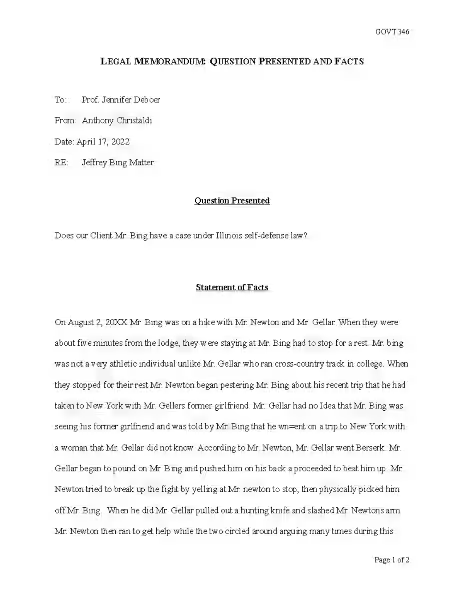
Crafting a compelling Question Presented is crucial for a successful legal memo. It's the compass that guides your analysis and ensures your argument remains focused and impactful. A poorly written Question Presented can lead to a muddled, ineffective memo, ultimately hindering your ability to persuade the reader. This guide will walk you through the essential elements of constructing a strong Question Presented.
- Understanding the Purpose of the Question Presented
- Key Characteristics of a Strong Question Presented
- Structuring the Question Presented
-
Examples and Avoiding Common Pitfalls
- How to Write Effective Questions for a Legal Memo?
- Q1: What is the purpose of questions in a legal memo?
- Q2: How do I identify the key issues to structure my questions around?
- Q3: Should my questions be broad or specific?
- Q4: How do I ensure my questions are focused on the legal issues?
- Q5: How can I phrase my questions to be concise and clear?
- Q6: What are common pitfalls to avoid?
- Q7: Are there examples of good vs. bad questions?
- Q8: How do I structure the questions within the memo?
- Q9: How do I ensure my questions are relevant to the desired outcome?
Understanding the Purpose of the Question Presented
The Question Presented isn't just a question; it's a concise statement of the core legal issue you're addressing in your memo. It's the lens through which the entire analysis is filtered. It acts as an immediate signal to the reader about the specific legal problem at hand, allowing them to quickly grasp the memo's core argument. A well-crafted Question Presented will directly address the specific legal issue you'll be analyzing, making the reader's understanding of the key legal problem evident from the outset. This clear articulation of the issue fosters a concise and focused approach to the legal analysis that follows.
This section is critical because it sets the stage for everything that follows. If the Question Presented isn't clear, the rest of the memo will likely suffer. Avoid vague or overly broad questions; instead, focus on the precise point of law you're seeking to resolve. A good Question Presented will naturally guide the reader towards the logical conclusion of the memo.
Key Characteristics of a Strong Question Presented
A powerful Question Presented is more than simply asking a question; it's a carefully structured statement. It should be:
- Precise: Avoid ambiguity and vagueness. State the legal issue as clearly and concisely as possible.
- Specific: Focus on the particular legal provision, precedent, or principle at issue.
- Neutral: Frame the question without taking a position. Maintain an objective tone.
- Concise: The Question Presented should be brief and to the point. Avoid unnecessary jargon or lengthy explanations.
- Focus on the Relevant Facts: Naturally, the question should refer back to the facts of the case. It should be grounded in the specific circumstances.
These characteristics ensure that your Question Presented does not just ask a question, but sets the stage for a compelling legal argument. A strong Question Presented will highlight the specific legal issue and will be an effective tool to guide your argument throughout the rest of the memo. It functions as the framework that shapes and supports the subsequent analysis.
Structuring the Question Presented
The structure of your Question Presented is vital. It establishes the framework for your memo and directs the reader to the heart of the legal problem. Following a structured approach creates a logical flow.
-
Identify the Key Legal Issue: What is the core legal problem at hand? This issue dictates the scope of your analysis.
-
Identify the Relevant Legal Principles: What legal principles are applicable to the specific issue? This will help shape your question.
-
Integrate the Facts: How do the facts of the case relate to the legal issue? This should be reflected in your question.
-
Craft a Concise Question: Transform the identified issue, principles, and facts into a clear and concise question.
By meticulously following these steps, you will ensure that your Question Presented is not just a question, but a purposeful and effective tool to guide the legal analysis. A structured approach will facilitate a clear and focused discussion of the legal issues.
Examples and Avoiding Common Pitfalls
Avoid overly broad or vague questions. For instance, instead of "Is the defendant liable for damages?", a more effective question would be "Given the facts of the case and the applicable precedent of Smith v. Jones, is the defendant liable for negligence under state law?" The second example provides context, specifics, and is grounded in the relevant legal principles.
Crafting the perfect question naturally involves practice. Review examples of well-constructed questions in legal memos and case briefs. Identifying the specific legal issue and integrating the relevant facts will help in formulating effective questions.
Mastering the art of crafting a Question Presented is paramount to writing effective legal memos. It's not simply asking a question; it's a precise statement of the core legal issue. By understanding its purpose, characteristics, and structure, you can create a Question Presented that effectively guides your analysis and persuades the reader. A strong Question Presented provides direction and focus, making your legal memo more impactful and persuasive. It is a critical component in the writing process, and developing proficiency in crafting these questions is a valuable skill that will serve you well in the legal field.
How to Write Effective Questions for a Legal Memo?
This FAQ section provides guidance on crafting effective questions for legal memos, ensuring clarity, focus, and relevance to the legal issue at hand.
Q1: What is the purpose of questions in a legal memo?
A1: Questions in a legal memo are not simply rhetorical; they actively guide the analysis and ultimately shape the conclusion. They serve to pinpoint the core legal issues, identify relevant facts, and direct the researcher toward a well-reasoned solution. Effective questions dissect the problem and lead the reader through the memo's logical progression.
Q2: How do I identify the key issues to structure my questions around?
A2: Carefully analyze the problem presented. Identify the key facts, the parties involved, and the potential legal arguments. Consider the specific statutes, regulations, or case precedents that might apply. Brainstorm potential areas of contention or uncertainty. From these factors, formulate questions that directly address the essential legal issues.
Q3: Should my questions be broad or specific?
A3: Aim for a balance between broad and specific. Begin with broader, foundational questions to establish the context and scope of the issue. Then, progressively refine these questions into more specific ones that address the details relevant to the legal arguments. This approach ensures clarity and avoids unnecessary tangents.
Q4: How do I ensure my questions are focused on the legal issues?
A4: Avoid questions that are too broad or too general. Focus on the legal implications of the facts. For example, instead of asking "What happened?", ask "What are the legal implications of the alleged breach of contract, given the specific clauses in the agreement?" Tie your questions directly to the applicable laws.
Q5: How can I phrase my questions to be concise and clear?
A5: Use precise and unambiguous language. Avoid jargon or overly complex legal terminology unless it's essential for clarity. Keep sentences short and direct. The wording should be clear enough to allow for a straightforward answer.
Q6: What are common pitfalls to avoid?
A6: Avoid asking questions that assume the answer. Avoid leading questions. Avoid questions that are irrelevant to the legal issues. Avoid excessively long or convoluted questions. Ensure that every question contributes meaningfully to the memo's analysis.
Q7: Are there examples of good vs. bad questions?
A7: Good questions are specific, focused on legal implications, and directly related to the core issues. Bad questions are too broad, vague, or assume a particular outcome. For instance, a good question is: "Does the recent amendment to the statute invalidate the existing contractual obligations?" A bad question is: "What are the implications of the incident?" Examples are best presented in the context of a specific hypothetical legal scenario.
Q8: How do I structure the questions within the memo?
A8: Organize your questions logically, following a natural progression of thought. Group related questions together to enhance readability and comprehension. The order should reflect the flow of the legal argument as it develops from initial assumptions to final conclusions. A good structure will guide the reader through the memo systematically.
Q9: How do I ensure my questions are relevant to the desired outcome?
A9: Identify the desired outcome of the memo. Focus your questions on the specific legal conclusions you wish to demonstrate. This ensures that the memo's analysis effectively supports the arguments needed to achieve the desired result.