
Does the McKinney-Vento Act Supersede State Law Regarding Student Transfers for Homeless Students?
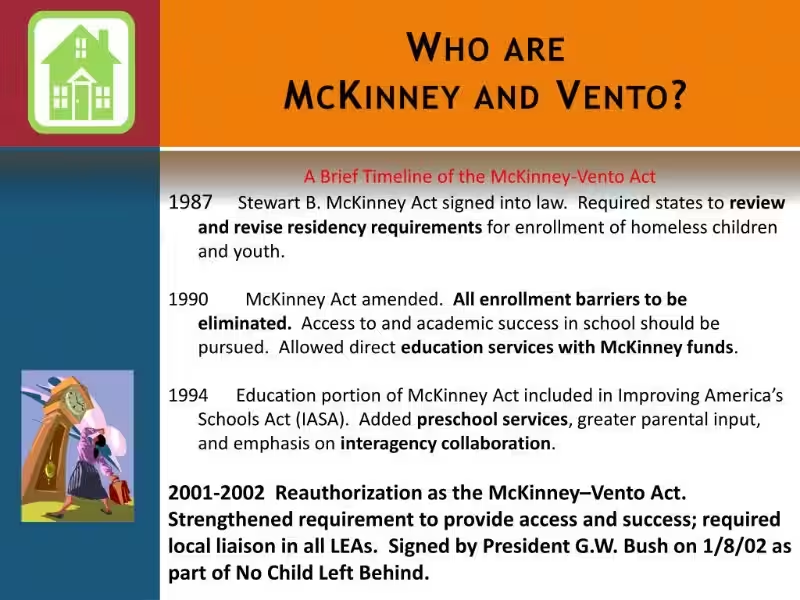
The McKinney-Vento Act, a crucial piece of legislation, outlines specific requirements for supporting students experiencing homelessness. A common question arises: when a student's best interest dictates a transfer from their school of origin, does the Act's federal mandate supersedes state law? This article will explore the complexities of this issue, providing a clear understanding of the Act's requirements and their implications.
- Understanding the McKinney-Vento Act's Role
- When a Transfer Might Be Necessary
- Proactive Intervention and Documentation
-
The Role of State Law
- Balancing Federal and State Regulations
- Frequently Asked Questions Regarding McKinney-Vento Act and Transfer Decisions
- Q1: Does the McKinney-Vento Act supersede state law regarding student transfers?
- Q2: What is the role of a Local Educational Agency (LEA) in determining a student's best interest?
- Q3: What factors should be considered when determining a student's best interest for a transfer?
- Q4: What constitutes "best interest" under the McKinney-Vento Act?
- Q5: What should the written explanation from the LEA include?
- Q6: How does the LEA need to support the student's attendance at the school of origin?
Understanding the McKinney-Vento Act's Role
The McKinney-Vento Act aims to ensure that homeless students have equal access to a quality education. A central tenet of the Act is that a student's school of origin should be their primary educational option. This means that the Act promotes in-school support and intervention before considering transfer to another school. The Act recognizes the unique needs of homeless students and their families, and seeks to mitigate the disruptions that often accompany homelessness. It provides a comprehensive framework for ensuring appropriate educational support.
Key Provisions & Their Importance
One crucial provision within the McKinney-Vento Act is the requirement for a local educational agency (LEA) to provide a written explanation, understandable to parents/guardians or unaccompanied youth, if they determine that attending the school of origin is not in the student's best interest. This explanation must also include information about appeal rights. This ensures transparency and accountability in the decision-making process. This written explanation is an important safety net, ensuring that families understand the reasoning behind any proposed transfer and that their rights are respected. Furthermore, it prevents arbitrary decisions and ensures that the student's well-being is prioritized.
When a Transfer Might Be Necessary
Naturally, situations arise where a transfer from a student's school of origin is genuinely in their best interest. Crucially, this determination isn't based on generalized attendance issues or a simple desire to transfer. A transfer is warranted only when substantial evidence demonstrates that the new school is a more suitable setting.
Evaluating the Student's Best Interest
The critical element in determining a student's best interest often involves objectively assessing factors impacting their ability to attend their school of origin. The LEA must demonstrate concrete efforts to support the student's enrollment and attendance. Some potential factors that might justify a transfer include:
- Significant commuting challenges: If the student faces significant logistical obstacles to attending school, such as long commutes or lack of accessible transportation.
- Student preference: The student might express a clear preference for the local school, and the LEA can demonstrate that this preference genuinely benefits their educational needs.
- Independent access: If the student can independently access the local school, potentially overcoming parental transportation issues.
These factors, when documented, demonstrate a genuine need for a transfer based on the student's specific circumstances and the LEA's attempts to address the underlying problems.
Proactive Intervention and Documentation
The act naturally emphasizes the importance of proactive intervention from the LEA to address attendance issues before considering a transfer. The LEA must document all attempts to remove barriers to attendance at the school of origin.
Demonstrating Support Efforts
The LEA's actions must show concrete attempts to support the student’s attendance at their school of origin. This could include:
- Individualized support plans: Developing and implementing plans tailored to address the student's specific needs.
- Transportation assistance: Exploring and providing transportation assistance if it's a legitimate barrier.
- Communication with parents and guardians: Maintaining open and proactive communication to address any concerns.
- Addressing any learning disabilities: Assessing and addressing any learning disabilities that might be hindering the student's academic success.
These efforts represent a comprehensive approach to supporting the student and demonstrate the LEA's commitment to the school of origin as the student's first educational choice. These steps must be thoroughly documented.
The Role of State Law
While the McKinney-Vento Act sets a federal standard for supporting homeless students, state laws can, in some cases, offer additional avenues of assistance. It is crucial to understand that the Act's requirements, regarding written explanations and appeal procedures, are federal standards that take precedence when determining a student's best interest.
Balancing Federal and State Regulations
In situations where state law might conflict with the McKinney-Vento Act, federal law naturally supersedes state law. This is crucial to ensure consistent support for homeless students nationwide. Understanding the interplay between these regulations is paramount to ensuring fair and equitable educational opportunities for all. State laws may offer resources that complement the Act, but the Act's mandates remain the primary legal framework.
In conclusion, the McKinney-Vento Act places a strong emphasis on the support of students experiencing homelessness, prioritizing their school of origin. The Act mandates a rigorous process for determining transfers, emphasizing the need for proactive intervention, a detailed written explanation, and a clear appeal process. School districts must diligently document efforts to support the student's attendance at their school of origin and ensure that any transfers are truly in the student's best interest, based on concrete evidence. By understanding and adhering to these provisions, schools can provide the best possible educational support to homeless students.
Frequently Asked Questions Regarding McKinney-Vento Act and Transfer Decisions
This FAQ addresses the legal requirements for transferring students experiencing homelessness under the McKinney-Vento Act, focusing on when a student's best interest necessitates a transfer from their school of origin.
Q1: Does the McKinney-Vento Act supersede state law regarding student transfers?
A: The McKinney-Vento Act provides specific guidelines for students experiencing homelessness. While state laws might exist, the Act's requirements, particularly regarding the "best interest" determination for transfers, must be adhered to. A transfer decision must comply with the federal law's standards.
Q2: What is the role of a Local Educational Agency (LEA) in determining a student's best interest?
A: The LEA must demonstrate a strong commitment to supporting the student's attendance at their school of origin. This includes proactive measures to remove attendance barriers. The LEA is not permitted to simply allow a student to transfer because of attendance issues without first documenting efforts to address the issues. Instead, the LEA must provide a thorough and understandable explanation, outlining why attending the student's school of origin is not in their best interest. This explanation must include information about appeal rights.
Q3: What factors should be considered when determining a student's best interest for a transfer?
A: The determination for a transfer must be student-centered. The LEA cannot base the decision on generalized attendance problems or a simple desire to transfer. Instead, the LEA needs to provide objective evidence that the student's attendance at a different school is truly in their best interest. Factors supporting a transfer might include significant commuting challenges, the student’s expressed preference for the new school, or their ability to access it despite parental transportation issues. Essentially, there needs to be concrete evidence supporting a transfer, not just a general statement.
Q4: What constitutes "best interest" under the McKinney-Vento Act?
A: "Best interest" means a determination based on concrete evidence that attendance at the new school is demonstrably better for the student. The LEA must thoroughly document efforts to address attendance issues at the school of origin and show why the student's needs are better met at the new school.
Q5: What should the written explanation from the LEA include?
A: The explanation must be understandable to both parents/guardians and unaccompanied youth. It must explicitly outline the reasons why attending the school of origin is not in the student's best interest, demonstrating the LEA's efforts to overcome attendance barriers. Crucially, it must also clearly explain the appeal process.
Q6: How does the LEA need to support the student's attendance at the school of origin?
A: The LEA must demonstrate active intervention and support efforts to address any barriers to attendance at the student's school of origin. This is crucial to establishing the validity of a transfer determination. Simply acknowledging an attendance issue is insufficient; the LEA must take concrete steps to resolve the situation.