
Is Eminent Domain Reserved Only for the Federal Government?
Eminent domain, the power of the government to seize private property for public use, is a complex issue often misunderstood. While the federal government certainly has this power, is it truly exclusive? This article will explore the multifaceted nature of eminent domain, clarifying its application across all levels of government—federal, state, and local.
This power isn't limited to the federal government. It's a fundamental aspect of government, enabling necessary public projects like building roads, schools, or utilities. This inherent power, not explicitly granted by any specific document, is essential for a functioning society. It’s a power that exists naturally within the very structure of governing authority. While the Fifth Amendment of the U.S. Constitution addresses eminent domain, specifically for the federal government, the principles of public use and just compensation are crucial to understand how this power is utilized at all governmental levels.
- The Fifth Amendment and Its Implications
- State and Local Eminent Domain
- Key Considerations for Public Use
- Just Compensation: A Necessary Balance
- Federal Supremacy vs. State Sovereignty
- Conclusion: Navigating the Complexities
-
Eminent Domain: A Shared Power
- Is eminent domain reserved only for the federal government?
- If not exclusive to the federal government, what about state and local governments?
- Does the Fifth Amendment's Takings Clause affect state and local governments?
- What are the limitations on the use of eminent domain at different levels of government?
- How does "just compensation" differ between entities?
- Does the federal government have supremacy over state governments in eminent domain matters?
- What is the importance of understanding the specific legal framework?
The Fifth Amendment and Its Implications
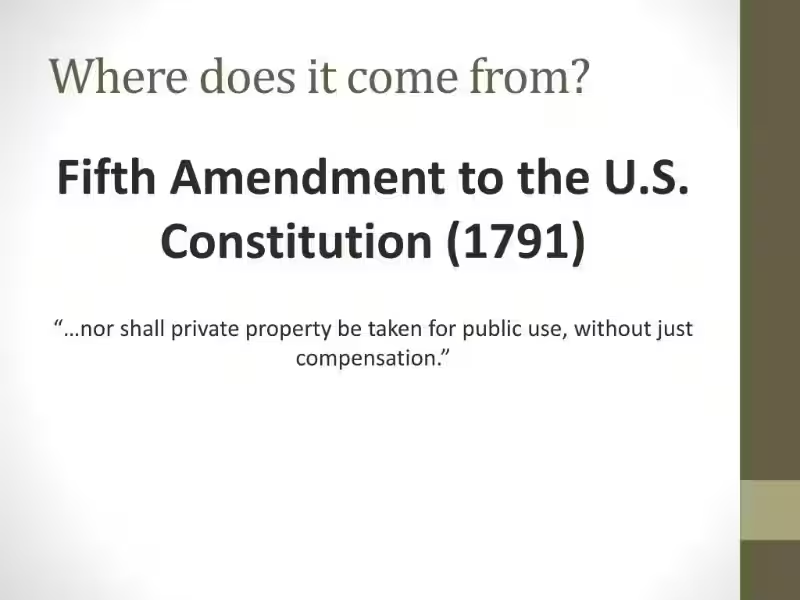
The Fifth Amendment's Takings Clause is central to understanding eminent domain. It states that the federal government can only take private property for public use, and it must provide "just compensation." Critically, this clause doesn't define what constitutes "public use," leaving room for interpretation over the years. This broad interpretation is a cornerstone of the government's ability to carry out essential projects.
The Fourteenth Amendment significantly expands the reach of the Fifth Amendment by extending its protections to state actions. This means that state and local governments, with properly authorized actions, are also subject to the principles of public use and just compensation when exercising eminent domain. This ensures a degree of fairness and consistency in how property rights are addressed across different governmental levels.
State and Local Eminent Domain
While the federal government plays a role, state and local governments also possess the power of eminent domain. This power is delegated to them by state law. North Carolina, for example, empowers local entities, and surprisingly, in some instances, even private companies, to use this power. This underscores the fact that eminent domain isn't the sole province of the federal government.
This delegation often involves specific criteria for the use of eminent domain, including the necessity of the project and the provision of just compensation. The "public use" requirement, while central to the right of eminent domain, can be more narrowly interpreted at the state and local levels. This is where the details of the specific state laws become crucial in understanding the limits of eminent domain.
Key Considerations for Public Use
The concept of "public use" has evolved over time. Early interpretations were quite broad, allowing for essentially any public benefit. Over time, however, courts have increasingly narrowed the parameters of what constitutes a legitimate public use. This includes requirements that projects must serve a legitimate public purpose and be necessary for the public good. These considerations are essential for ensuring that private property rights are not unduly compromised and that the power of eminent domain is not abused. This scrutiny ensures that it is truly a tool for the benefit of the public, and not simply for private gain.
Understanding the nuances of "public use" is critical. For example, private benefit should not be the driving factor behind eminent domain. While it appears to be an exceptional power, it must be executed in a fair manner, considering the impact on private property rights.
Just Compensation: A Necessary Balance
"Just compensation" is another crucial aspect of eminent domain. While the principle is the same across all levels of government, the practical application can vary considerably. Determining a fair market value for property can be complex and often requires expert appraisal. This is why consulting with legal counsel is highly recommended when considering eminent domain actions, especially when dealing with complex or contested situations.
The need for "just compensation" is a guiding principle in the process, but the actual amount and calculation can vary significantly depending on the specific circumstances. Legal counsel should be consulted to fully understand the implications of specific legislation and the financial implications for affected landowners.
Federal Supremacy vs. State Sovereignty
It is essential to understand that the federal government's power of eminent domain doesn't completely overshadow the rights of the states. The federal government's supremacy in law does not eliminate the independent authority of the states regulating eminent domain. While the Fifth Amendment's provisions are binding on the states through the Fourteenth, state laws often fill in the specifics of how eminent domain is exercised within their borders. This framework creates a dynamic interplay of power and responsibility between the federal and state governments.
The balance between federal supremacy and state sovereignty is critical in ensuring that constitutional protections are upheld. This balance, when exercised correctly, protects the rights of both the government and the citizenry.
In conclusion, eminent domain is not a power reserved solely for the federal government. States and local governments, naturally, also possess and exercise this power, though within the constraints of their own jurisdictions and constitutional limitations. The Fifth and Fourteenth Amendments provide essential protections regarding these powers. Understanding the specific legal framework at each level is crucial for anyone whose property might be affected by such actions. Seeking legal counsel is strongly advised to navigate the complexities and ensure your rights are protected.
This FAQ addresses the question of whether the power of eminent domain is exclusive to the federal government.
Is eminent domain reserved only for the federal government?
No. The power of eminent domain is not exclusive to the federal government. It's inherent to all levels of government – federal, state, and local. This inherent power, essential for governmental functions, isn't explicitly granted by any specific document.
If not exclusive to the federal government, what about state and local governments?
State and local governments also possess the power of eminent domain, as well as, in some cases, certain private entities. This power is derived from their sovereign authority and is often delegated through state statutes. However, the inherent power is still subject to regulations.
Does the Fifth Amendment's Takings Clause affect state and local governments?
Yes. While the Fifth Amendment's Takings Clause directly limits the federal government's use of eminent domain, requiring public use and just compensation, the Fourteenth Amendment extends these limitations to the states. Therefore, both federal and state governments must adhere to these principles when exercising eminent domain.
What are the limitations on the use of eminent domain at different levels of government?
All levels of government, when exercising eminent domain, must adhere to the requirements of public use and just compensation. The specific legal framework governing these principles varies between jurisdictions, necessitating consultation with legal counsel in each case.
How does "just compensation" differ between entities?
The practical application of "just compensation" can vary significantly between federal, state, and local governments, as well as between different actors exercising eminent domain. Therefore, legal counsel is critical to understanding and ensuring appropriate compensation in any given situation.
Does the federal government have supremacy over state governments in eminent domain matters?
While the federal government holds supreme authority in certain areas of law, its supremacy in eminent domain matters isn't absolute. State governments maintain independent authority in this area, subject only to the Fifth and Fourteenth Amendment limitations.
What is the importance of understanding the specific legal framework?
Understanding the specific legal framework governing eminent domain at the federal, state, and local levels is vital for anyone whose property may be affected by such actions. The regulations, including public purpose and just compensation, are crucial for safeguarding private property rights.